

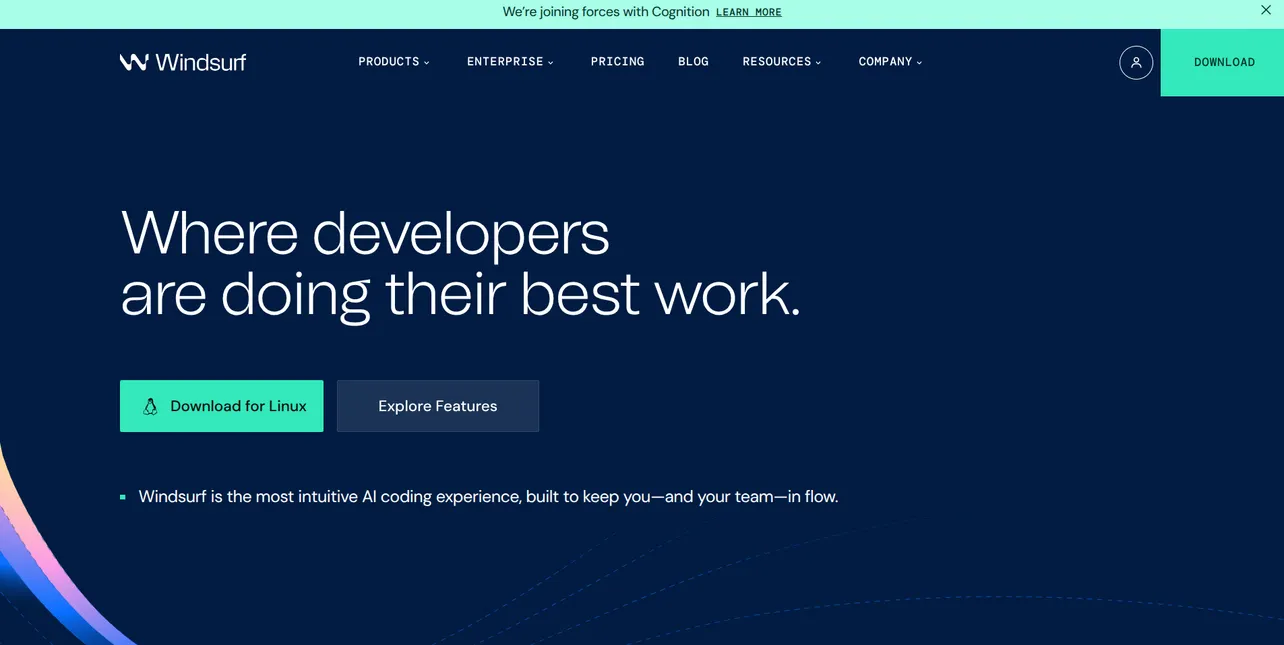
Four months to 1 million developers. In a market that everyone said was saturated. Let's break down exactly how Windsurf pulled this off.
The Setup: Everyone Said It Was Too Late
Late 2024, and the AI coding assistant market looked crowded as hell. GitHub Copilot had millions of users and Microsoft's backing. Cursor was the hot new startup with an AI-first approach. Dozens of other tools were fighting for whatever scraps remained.
| Player | Advantage |
|---|---|
| GitHub Copilot | Millions of users, Microsoft backing |
| Cursor | Hot startup, AI-first approach |
| Tabnine | Years of market presence |
| Dozens of others | Fighting for scraps |
Conventional wisdom said don't even try.
But Varun Mohan and his team saw something different. They saw a market full of tools that technically worked but felt clunky as hell.
Good AI, terrible experience.
The Core Problem: Breaking Flow
Here's what using most AI coding tools actually felt like in practice.
You'd either use autocomplete mode, which was great for boilerplate but useless for any complex thinking.
Or you'd use chat mode, which meant stopping your work, opening a separate panel, explaining what you wanted, waiting for a response, copying and pasting code, then trying to resume work if you could even remember where you were.
Option 1: Autocomplete Mode
- Good for boilerplate
- Useless for complex thinking
- Still need to write the interesting parts yourself
Option 2: Chat Mode
- Stop what you're doing
- Open a separate panel
- Explain what you want
- Wait for response
- Copy-paste code
- Resume work (if you remember where you were)
Every single time you used the AI, you broke your flow state. That context switching was murder for productivity. The tools were helpful, sure, but they weren't transformative.
"The best tools disappear into your workflow. You forget you're using them."
That became the bet. Build something that felt like a thought partner working alongside you, not a chatbot you had to manage.
Building Windsurf with Varun Mohan. Source: Lenny's Podcast
The Big Idea: Flow Mode
Instead of asking "how do we make better AI suggestions?", Windsurf asked a fundamentally different question. What if AI could understand your codebase so deeply that it felt like it was thinking alongside you?
What if it could anticipate what you were trying to do and help you get there without breaking your concentration?
This meant the AI needed to understand your entire codebase, not just the file you were editing. It needed to anticipate what you were trying to do and make suggestions that felt natural. No context switching, no breaking flow, just seamless collaboration.
They called it "flow mode." And building it turned out to be brutally hard.
 Chloe Ferguson
The Technical Challenge: Making Magic Actually Work
Part 1: Understanding Context
Most AI coding tools take the lazy approach. They send a chunk of your current file to an LLM and call it a day. It's fast, it's cheap, but it's also incredibly shallow.
Windsurf built something way more sophisticated. They created a semantic index of your entire codebase that maintains real-time understanding of where functions are called, what they depend on, your coding patterns, your team's conventions, and all relevant docs and type definitions. This context engine runs continuously in the background, building and updating a knowledge graph of your code.
What the context engine knows:
- Where functions are called
- What they depend on
- Your coding patterns
- Your team's conventions
- Relevant docs and type definitions
It's computationally expensive and technically complex. But it's what makes the AI feel genuinely intelligent instead of just doing fancy pattern matching.
Part 2: Multi-File Intelligence
This is where Windsurf really separates itself from the competition. When you ask it to refactor a component, it doesn't just change one file and call it done. It updates all the imports, adjusts related tests, fixes type definitions, and handles edge cases you might have forgotten about.
Coordinated changes across:
- All the imports
- Related tests
- Type definitions
- Edge cases you forgot
Most competitors can't do this reliably.
It requires understanding the dependency graph of your code, reasoning about side effects and potential breaking changes, maintaining consistency across different coding styles, handling version control conflicts intelligently, and doing all of this fast enough that it doesn't break flow.
It's unglamorous infrastructure work that doesn't make for sexy marketing demos, but it's the difference between a toy and a tool you trust with production code.
Part 3: Speed Matters More Than You Think
Here's something most people building AI products miss completely.
If your AI takes 5 seconds to respond, developers won't use it for anything beyond simple tasks. They'll context switch, check Twitter, and lose their entire train of thought.
Windsurf obsessed over latency from day one. They built custom caching layers, optimized model inference, and architected the system to start showing results incrementally instead of waiting for the complete response.
The goal was to make the AI feel instant, even when it was doing complex reasoning behind the scenes.
In developer tools, performance isn't a feature. It's THE feature.
The speed stack:
- Custom caching layers
- Optimized model inference
- Incremental results (show something immediately)
- Goal: Feel instant, even when reasoning is complex
The Launch: Developer-Led Growth Done Right
Windsurf didn't waste time on press releases or expensive ad campaigns. They went straight to where developers actually hang out: Twitter, Reddit, Hacker News, and Discord. No corporate bullshit, just real conversations with real developers.
Building in Public
Months before the official launch, the team started sharing their progress publicly.
They posted screenshots of new features, talked openly about technical challenges they were solving, and engaged directly with developers who had feedback or feature requests.
This transparency built trust before they even had a product to sell.
GPT-5.1 and GPT-5.1-Codex are now live in Windsurf
— Windsurf (@windsurf) November 13, 2025
All paid users get free access for the next 7 days. GPT-5.1 is also set as the default model for new users. pic.twitter.com/ZmwczPnAy3
Windsurf are transparent about their processes on X, but also on their blog too.
The Codeium Advantage
Here's the plot twist that gave them a massive head start.
Windsurf wasn't starting from zero users. Their previous product, Codeium, already had hundreds of thousands of users who trusted the team to build great developer tools.
When Windsurf launched, they had a built-in audience of developers who were eager to try the next evolution.
These early users provided critical feedback, helped identify bugs, and became advocates spreading the word. That initial momentum is nearly impossible to manufacture from scratch.
Freemium Strategy
Windsurf made a bold and expensive decision.
They made the product free to try with no credit card required and no artificial limitations that would prevent developers from experiencing the core value.
This is way harder than it sounds because AI queries cost real money in compute and API calls.
The bold move:
- Free to try, no credit card
- No artificial limits on core features
- Bet on quality driving upgrades
Most companies aggressively limit free usage to control costs. Windsurf bet that if the product was genuinely better, power users would naturally hit limitations and upgrade to paid plans.
They were right, and the conversion rates proved it.
Going Viral Through Quality
Within weeks of launch, Twitter exploded with developers posting screenshots of Windsurf doing something genuinely impressive.
Reddit threads turned into heated debates about whether it was better than Cursor. YouTube creators started making detailed comparison videos without any sponsorship deals.
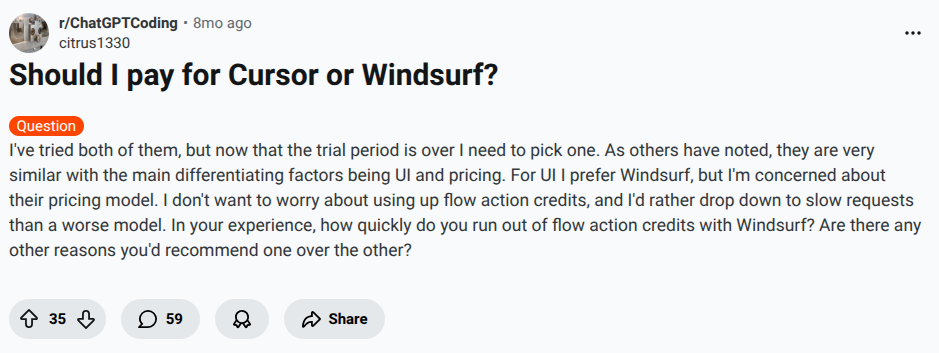
This wasn't manufactured viral growth or paid influencer marketing. The product was legitimately good enough that developers wanted to share it with their peers. That's the dream scenario: your users become your marketing team because they're genuinely excited about what you built.
The Numbers: How They Hit 1M
The growth trajectory tells the whole story. Month one brought 50K users from the initial push to Codeium users and developer communities. Month two saw word of mouth accelerate to 200K as comparison videos and threads started appearing organically.
| Month | Users | What Happened |
|---|---|---|
| 1 | 50K | Launch to Codeium users + dev communities |
| 2 | 200K | Word of mouth accelerates |
| 3 | 500K | Mainstream dev media coverage |
| 4 | 1M+ | Network effects kick in |
By month three, mainstream developer media picked up the story and user count hit 500K. Month four is when network effects really kicked in as developers started bringing their entire teams, pushing past the 1 million user mark.
What made this hockey stick possible:
✅ Product was genuinely 10x better at something specific (flow)
✅ Onboarding took less than 5 minutes start to finish
✅ Team stayed active and responsive in communities
✅ Perfect timing when devs wanted better AI tools
The Moat: Why Competitors Can't Just Copy This
Here's the uncomfortable truth for anyone trying to compete. Everyone has access to the same AI models now - GPT-4, Claude, whatever. That part is completely commoditized. So what's actually defensible when the core technology is available to everyone?
1. Context Management Infrastructure
Building a system that maintains semantic understanding of large codebases in real-time isn't something you can spin up in a weekend sprint.
It requires deep expertise in compiler design, graph algorithms, incremental computation, and distributed systems. Windsurf spent years building this infrastructure for Codeium, and competitors would need similar time and resources to catch up.
2. Trust and Brand
Once developers trust a tool with their production code, switching costs become surprisingly high.
Not just technically, but psychologically - you learn the quirks, develop muscle memory, integrate it into your workflow. Windsurf is building this trust rapidly by being consistently reliable, fast, and genuinely useful, which is incredibly hard to displace once it's established.
3. Data Flywheel
Every interaction with Windsurf generates valuable data about what developers need, what works, and what doesn't.
This data makes the product better, which attracts more users, which generates more data. The flywheel is just getting started for Windsurf, but for competitors without a similar user base, catching up becomes exponentially harder over time.
The Hard Parts Ahead
Let's be honest about the challenges that come with this kind of rapid growth. Success creates its own set of brutal problems that can kill companies just as easily as failure.
Scaling Infrastructure
Going from 1 million to 10 million users isn't just about buying 10x more servers.
It's fundamentally different classes of scaling problems where databases that worked fine at small scale need complete rearchitecture. Costs that seemed manageable at launch can become existential threats when they scale linearly with users.
Enterprise Sales
Individual developers might love Windsurf, but enterprise adoption is a completely different beast.
You need security certifications, compliance documentation, admin controls, SSO integration, and all the unsexy infrastructure that makes procurement departments happy.
This requires building an actual sales team, creating enterprise pricing tiers, and probably sacrificing some of the simplicity that made the product great in the first place.
Maintaining Quality
When you're growing this fast, the pressure builds to ship more features, support more languages, integrate with more tools, and expand into adjacent markets.
The real risk is losing focus on what made the product special in the first place - that seamless flow experience. Feature bloat has killed more successful products than lack of features ever has.
Competition Will Respond
Microsoft, GitHub, and other major players aren't going to sit still and watch.
They're paying attention, learning from Windsurf's success, and they have way more resources, deeper pockets, and existing distribution advantages.
Windsurf's edge is speed and focus, but that advantage only lasts as long as they can consistently out-execute the giants.
What You Can Learn From This
If you're building in what looks like a "crowded" market, here's the actual playbook that works.
1. Find the Real Friction
Don't just build a marginally better version of what already exists. Find the fundamental friction in how people use existing solutions and completely eliminate it.
Windsurf didn't build better AI suggestions - they built a fundamentally better way to interact with AI that didn't break your flow.
2. Infrastructure Is Your Moat
In the age of commoditized AI models, everyone has access to the same underlying technology.
Your competitive advantage comes from the unglamorous infrastructure work, domain expertise, and design decisions that make those models actually useful in practice.
That's what's defensible.
3. UX Is Everything
This is especially true in developer tools, where UX isn't just important - it literally is the product.
A technically inferior tool with significantly better UX will often beat a technically superior tool with clunky UX. Developers value their time too much to fight with bad interfaces.
4. Kill Friction in Onboarding
Every single second of friction between someone hearing about your product and experiencing real value is a conversion killer.
Windsurf nailed this with an onboarding experience that required no demo calls, no credit card, no complex setup - just download and start using it immediately.
5. Let Quality Drive Growth
If you build something that's 10x better at solving a real problem, your users naturally become your marketing team. But the improvement has to be obviously better to the point where people feel compelled to share it, not just marginally better.
Marginal improvements don't get talked about.
6. Stay Lean, Stay Focused
Rapid growth creates enormous pressure to hire aggressively and start building everything everyone asks for.
Fight this urge with everything you have. Small teams move faster, ship higher quality work, and stay focused on what actually matters instead of getting lost in organizational complexity.
7. Build for Enthusiasts First
Don't try to be everything to everyone from day one. Make the enthusiasts in your space absolutely fall in love with your product. Let that enthusiasm and word of mouth naturally pull you into adjacent markets over time.
The Real Lesson
Here's what most people get wrong about "saturated markets." A saturated market is usually just code for "a market full of mediocre solutions that work well enough that companies stopped innovating."
True saturation only happens when someone has built something users genuinely love and can't imagine living without.
Windsurf proved that timing isn't about being first. It's about being right.
They entered the market when developers were already comfortable with AI coding tools but deeply frustrated with the actual experience of using them. They built something that was obviously better and made it ridiculously easy to try.
Distribution took care of itself from there.
Your Turn
If you're staring at what looks like a crowded market right now, remember something important. The best product doesn't always win in the real world. But a dramatically better product combined with smart distribution usually does.
Here's what you actually need to do:
Focus obsessively on the user experience until it's not just good but genuinely delightful. Build infrastructure that compounds in value over time rather than just chasing features.
Stay small, stay fast, and maintain the speed that lets you out-execute bigger competitors. Ship something so obviously good that people can't help but share it with others.
That's how you go from zero to a million users in four months. Not by playing it safe and making incremental improvements to existing solutions. By building something genuinely worth talking about.