


Most startup ideas don't fail because the execution was wrong. They fail because nobody wanted them in the first place, and the founder spent six months and £15,000 finding that out.
Validation is the work you do before you write code. Before you incorporate. Before you tell your friends you're "doing a startup." It's the part most founders skip because building feels productive and validation feels like procrastination.
In 2026, that calculation has flipped.
AI tools have made it possible to test demand, gauge willingness to pay, and even talk to potential customers without building anything more than a Notion page and a paid ads account. The cost of validating an idea has dropped to near-zero. The cost of skipping validation has not.
Here's how to do it properly.

Why most "validation" isn't actually validation
Before getting into the methods, it's worth being honest about what doesn't count.
- Asking your friends if they'd use it doesn't count. They'll say yes. They love you.
- Posting on LinkedIn and getting 47 likes doesn't count. Likes are not pre-orders.
- Your own conviction that "this needs to exist" doesn't count. Every founder believes this. Most are wrong.
Real validation has one quality: someone who isn't your mum demonstrates that they want the thing badly enough to do something about it. Pay you. Sign up. Give you their email knowing you'll bother them later. Take a 30-minute call. The currency varies but the principle doesn't change. They have to put something on the line.
Anything softer than that is enthusiasm, not evidence.
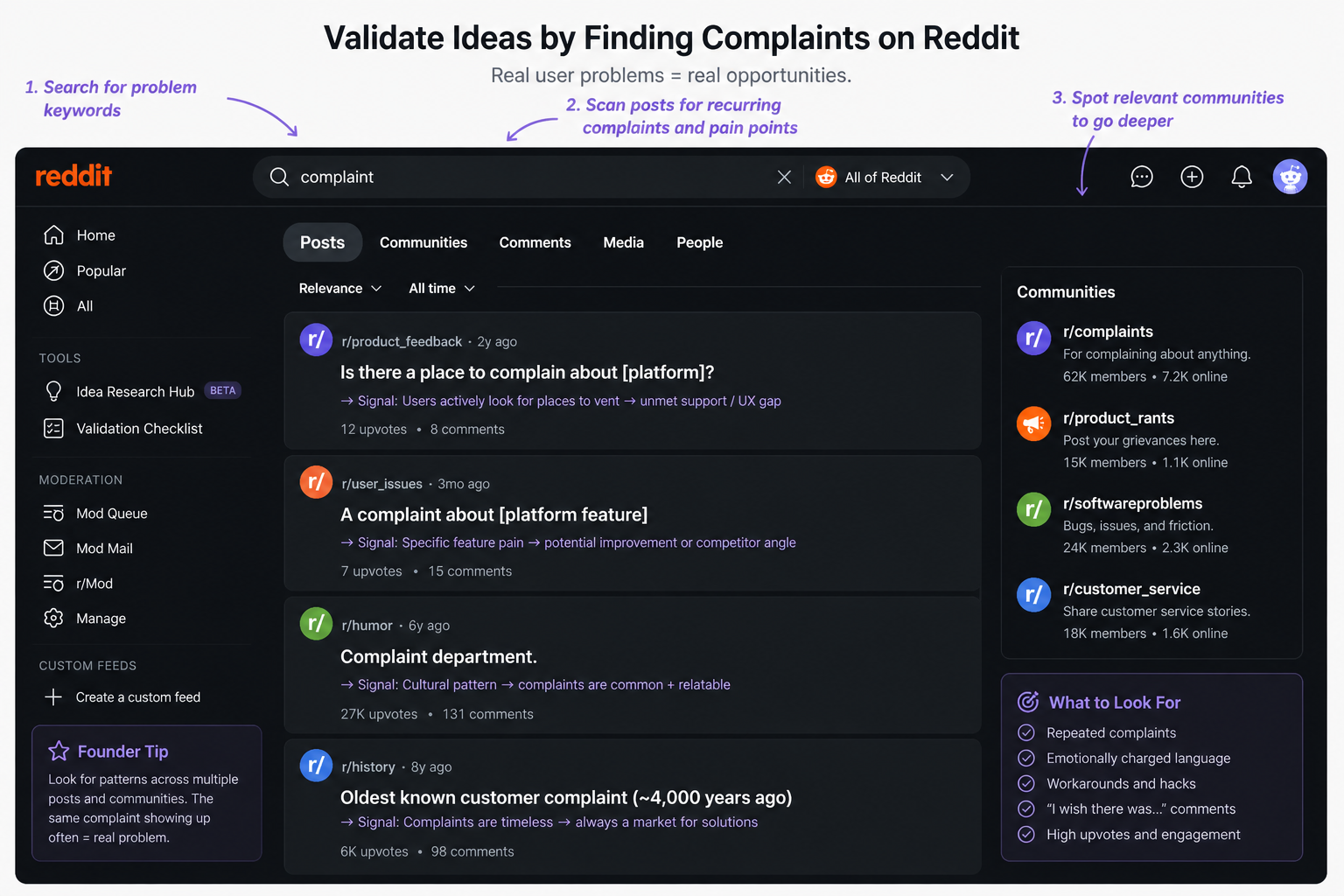
Method 1: Mine real complaints (lowest effort, highest signal)
The fastest way to validate an idea isn't to ask people what they want. It's to find places where people are already telling you what's broken.
Reddit, G2 reviews, Twitter/X gripe threads, Trustpilot one-star reviews, and Upwork job listings are all signal-rich. People don't sugarcoat problems on Reddit. They vent in specifics. "I've been trying to do X for three weeks and tool Y keeps breaking." That's a brief.
This is exactly the playbook Om Patel used to validate over 10,000 product ideas before building BigideasDB. The fundamental insight: you're not creating demand, you're capturing it.
Practical workflow:
- Pick three subreddits relevant to your space. Sort by "New" rather than "Top." You want fresh problems, not popular ones.
- Search G2 and Trustpilot for the incumbent tools. Filter to one and two-star reviews.
- Browse Upwork for jobs that describe the manual workaround for your idea. If 50 people are paying freelancers $200 to do something a tool could automate, that's a market.
Time investment: an afternoon. Cost: zero.
Method 2: The smoke test landing page
The classic validation move, and still one of the best. You build a single landing page describing the product as if it already exists, run a small ads budget at it, and measure how many people sign up for the waitlist or click "Buy Now."
What's changed in 2026 is the build cost. A landing page that would have taken a developer two days now takes 20 minutes in Lovable, Webflow, or Framer. Copy can be drafted by Claude or ChatGPT in minutes. You can have a credible-looking page live by lunchtime.
The setup that works:
- A clear headline describing the problem you solve, not the feature you're shipping
- One paragraph of explanation, no more
- A "Get early access" form or a fake "Buy now" button that takes them to a "We're still in beta, here's the waitlist" page
- Honest copy. Don't lie about the product existing. Frame it as "we're building this. Want in?"
The fake door variant is more aggressive: you put up a "Buy now" button at a real price point, and when someone clicks it, they hit a "We're sold out, join the waitlist" page. Genuinely shows willingness to pay rather than just curiosity. Some founders find this ethically dodgy.
The compromise is being honest in the waitlist message about what just happened.
Method 3: The pre-sale (the gold standard)
If method 2 feels theatrical, this is the real version. Charge people money before the product exists.
Pre-orders are the cleanest validation signal possible. Someone parting with £29 or £199 to get on a list is doing a much harder thing than typing their email into a form. It's the only validation method that proves willingness to pay rather than just willingness to express interest.
Mechanically simple in 2026:
- Stripe payment link, takes 90 seconds to set up
- Lemon Squeezy or Gumroad if you want a checkout page with more polish
- Founding member pricing: make the early tier visibly cheaper than the eventual price, so there's an actual incentive to commit now
The ethical version is being clear about timeline ("shipping Q3 2026") and offering a no-questions refund policy. The unethical version is taking money for something you have no real intention of building. Don't do the second one.
Method 4: Customer interviews, but done properly
Talking to potential customers gets dismissed as soft validation, but it's only soft if you do it badly. The Mom Test by Rob Fitzpatrick is the canonical text on doing it well, and the core idea is simple: don't ask people about hypotheticals, ask them about the past.
Bad question: "Would you use a tool that does X?"
Good question: "Tell me about the last time you ran into this problem. What did you do?"
The first question gets you opinions, which are nearly worthless. The second gets you behavior, which is signal.
Where AI changes the game in 2026 is in the recruiting phase. Cold outreach to find 10 potential customers used to take a week. Now:
- Use Apollo or Clay to build a list of people in your target segment
- Use Lindy or a similar AI agent to handle the outreach sequence and book the calls into your calendar
- Run 20-minute calls, transcribe with Otter or Granola, ask AI to pull patterns across the transcripts
Aim for 15–20 conversations. Patterns that show up in three or fewer interviews are noise. Patterns that show up in 10+ are signal.
Method 5: The community-first move
Build the audience before the product. This is the slowest validation method but produces the strongest go-to-market position if it works.
The mechanics:
- Pick one channel where your target customer already hangs out (Twitter/X for indie hackers and AI builders, LinkedIn for B2B SaaS, TikTok for consumer, Discord and Reddit for niche communities)
- Post regularly about the problem space, not the product
- Build to 1,000 engaged followers before you ship anything
When the product launches, you have a built-in audience that already trusts you on the topic. The validation isn't a survey or a sign-up. It's whether your content resonates. If you can't get attention writing about the problem, you won't get attention selling the solution.
The signal here is qualitative: are people DM-ing you to ask follow-up questions? Are they sending you their own examples? Are strangers tagging friends in your posts? Engagement that goes beyond likes is the early proof that the topic has pull.
What to do with what you learn
Validation isn't a binary pass/fail. Most ideas come back with mixed signals: some demand, some confusion about pricing, some pushback on the specific approach. The job isn't to get a "yes." It's to learn enough to make the next decision rationally.
Three useful outcomes from a validation sprint:
Strong signal: proceed
Multiple methods point the same direction. Pre-sales convert. Interview patterns repeat. Build a v1 with confidence.
Mixed signal: pivot the angle
The problem is real but your specific framing isn't landing. Adjust the messaging, the pricing, or the customer segment, and re-test. This is where most ideas actually live.
Weak signal: Kill it or Shelve it
Nobody's biting at any price, the interviews are flat, the landing page converts at 0.4%. Walk away. The hardest skill in early-stage building is killing your own ideas before they kill your runway.
The founders who get good at this aren't the ones with the best ideas. They're the ones who validate fastest and waste least time on the wrong things.
A 30-day validation sprint
If you want a concrete plan rather than a menu of options, here's a sequence that works for most software/SaaS ideas:
Week 1
Mine complaints. Reddit, G2, Upwork. Document the top three recurring problems and the language people use to describe them.
Week 2
Build a smoke test landing page. Use the language from week 1. Drive £100–200 of paid traffic. Measure conversion.
Week 3:
Interview 10 people from the waitlist. Use Mom Test framing: past behavior, not hypothetical preferences. Look for patterns.
Week 4:
Run a pre-sale at founding member pricing. Three pre-orders is your green light. Zero pre-orders is your data.
Total cost:
£200–500 in ad spend, plus your time. Total signal: enough to make a real decision either way.
The startups winning in 2026 aren't the ones with the best ideas. They're the ones that figured out which ideas were actually worth building before they wasted six months building the wrong one.
FAQs
How long should startup validation take?
Two to four weeks for most software ideas. Long enough to mine real signal, short enough to keep momentum. The goal is a clear go/pivot/kill decision, not a perfect answer.
How much money do I need to validate an idea?
Under $500 covers most validation work in 2026: landing page tools, ad spend, and AI subscriptions. Pre-sales can recoup most of it if the idea has legs.
What's the single best validation signal?
Money changing hands. Pre-orders or paid commitments are the only validation that proves willingness to pay rather than willingness to express interest. Everything else is softer signal.
Can I skip validation if I'm passionate about the idea?
You can, but you'll spend longer finding out the same thing. Passion is fuel, not evidence. The validation work isn't there to test your conviction. It's there to test whether anyone else shares it.
What if my validation comes back negative?
You've saved yourself months. Negative validation is a feature, not a bug. The cost of finding out an idea doesn't work in week three is trivial compared to finding out in month nine after you've quit your job.