

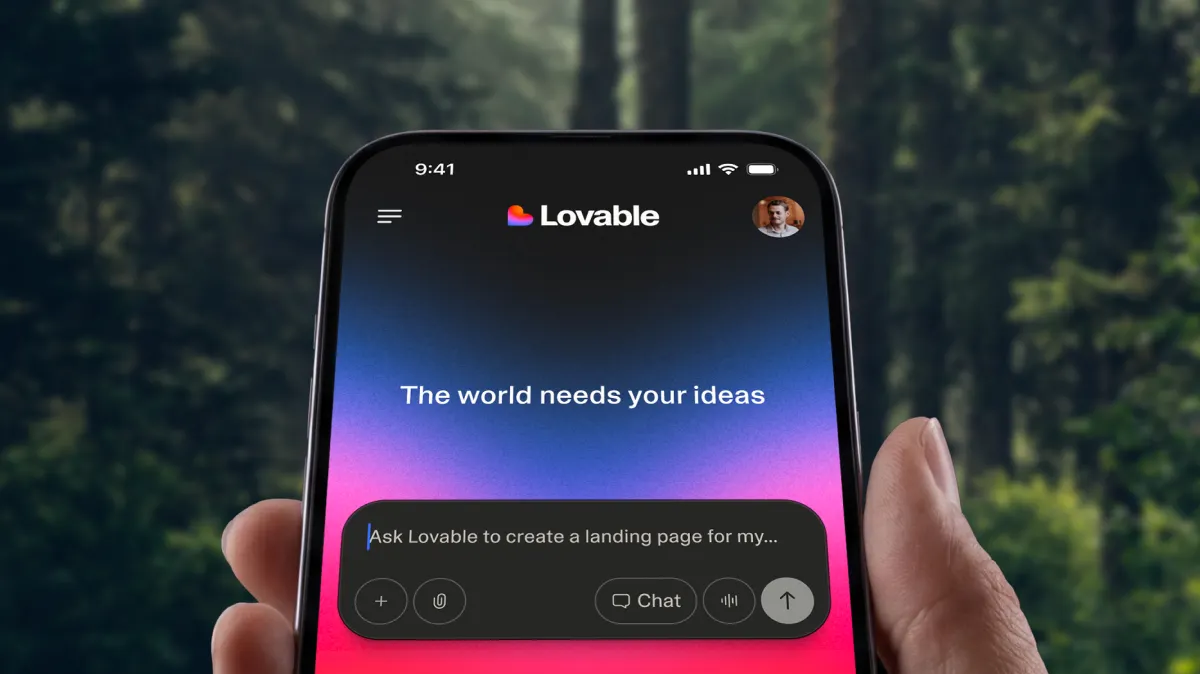
Lovable just dropped a mobile app. Everything you can build on the web, now in your pocket. Queue prompts on the bus, get a push notification when your build is ready, then pick up where you left off when you're back at your laptop.
That's the pitch. And on the surface it sounds like another "we made an app for our app" announcement that gets a polite nod and goes back into the inbox.
But this one's worth paying attention to. Here's why.
What's actually shipping
Three features doing most of the work in the launch email:
Prompt queueing. You stack ideas as they come, and Lovable works through them in the background. No more losing the 2am idea because you're in bed without your laptop.
Push notifications. When a build finishes, your phone tells you. You're not babysitting a progress bar in a browser tab.
Cross-device continuity. Start a project on desktop, refine it on mobile, jump back to desktop. The session follows you.
Why this matters more than a typical "we have an app now" launch
Most SaaS mobile apps are companion experiences. You log in to check a dashboard, approve something, or scroll a notification feed. The actual work still happens on desktop.
Lovable's mobile app is doing something different. The work is the prompt. The build runs on Lovable's infrastructure regardless of whether you typed the prompt on a 27-inch monitor or a phone screen on the train.
There's no "stripped-down mobile version" of the product because the product was already async and infrastructure-side from day one.
That makes vibe coding genuinely portable for the first time. Not "I can review my GitHub commits on the toilet" portable. I can ship a feature on the toilet portable. Whether that's a good thing for software quality is a separate conversation.
The strategic read
Lovable hit $200M ARR within months of launch and has been pushing hard into being the default AI app builder for non-technical founders. Going mobile native is a retention play more than an acquisition play.
Here's the logic. Founders who build with Lovable are typically juggling a day job, a side project, and a calendar that doesn't allow for two-hour deep work blocks at a desk.
The friction of "I have an idea, I'll write it down, I'll get to it later" is where momentum dies. Drop that friction to "I have an idea, I queue it now, I review the result on the train home" and you've turned the platform into something that fits real founder schedules.
What this isn't
Worth being clear: this isn't Lovable shipping native iOS or Android binaries from the platform itself.
The web-only output limitation is still there. If you want your Lovable project on the App Store, you still need a wrapper service or an export-and-rebuild workflow.
That distinction is important if you've been waiting for Lovable to compile to native. This isn't that announcement.
What founders should actually do with this
A few honest takes on how this fits into a real workflow:
Use it for prompt capture, not heavy lifting. Mobile is great for the "I just thought of this" moment. It's not great for reviewing complex multi-component changes or debugging styling. Treat it like a notebook that happens to also build.
Lean into the queue. The async build model rewards batching. Queue four or five prompts in the morning, review the results over coffee. That's a different workflow to the desktop "tweak, watch, tweak" loop, and it suits early-stage solo work surprisingly well.
Don't ship from your phone. Or at least, don't deploy production changes from your phone without seeing them on a real screen first. The temptation will be there. Resist it.
The bigger pattern
Mobile-first development tools used to be a contradiction. You built code on desktops, full stop. The combination of cloud build infrastructure, async AI agents, and decent mobile UX has changed that.
Lovable's the most visible example, but it won't be the last. Expect Cursor, Replit, and probably Bolt to ship some version of this in the next six to twelve months. The shape of the workflow is going to keep shifting toward "describe it on the move, deploy it from anywhere."
Worth watching, even if you're not currently a Lovable user.
The Android app is live on Google Play now. iOS is rolling out via the App Store.
Already vibe coding? Our ultimate vibe coding stack guide breaks down which tools are actually worth using in 2026.
New to AI app building? Read our take on how non-coders are shipping real apps and what really happens when you try to build with AI.
Curious about Lovable specifically? We covered Lovable's pricing shift earlier when the platform started signalling it was getting serious.
FAQ
Is the Lovable mobile app free?
The app itself is free to download. You'll need a Lovable account, and the platform's existing pricing tiers apply – credits, project limits, and feature access work the same on mobile as on the web.
Does the Lovable mobile app build native iOS or Android apps?
No. The mobile app is an interface for using Lovable on your phone. The apps you build with it are still web apps. To ship a Lovable project to the App Store or Google Play, you still need a wrapper service like Median, Capacitor, or one of the dedicated Lovable-to-mobile platforms.
Can I switch between mobile and desktop on the same project?
Yes. That's one of the main features of the launch. Sessions sync, so you can start on one device and continue on the other.
When did Lovable launch the mobile app?
The mobile app rolled out in late April 2026, with the Android version already showing 100K+ downloads on Google Play and the iOS release rolling out alongside it.
Is Lovable available on both iOS and Android?
Yes, both platforms. Search "Lovable: Build Apps With AI" in the Google Play Store or "Lovable AI" in the App Store.