
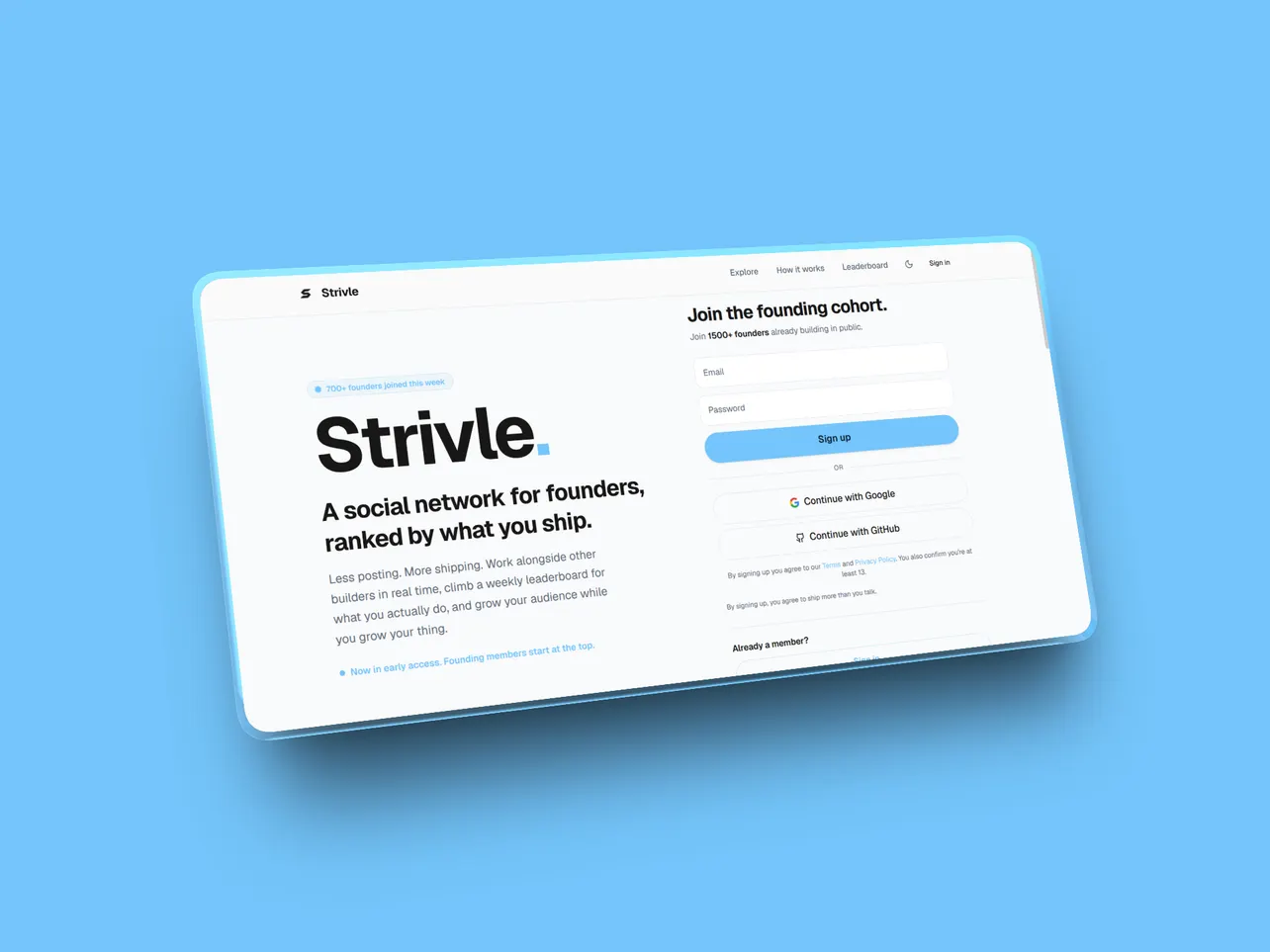
Most builders complain about X and LinkedIn. One bored Saturday, a 19-year-old in Sweden opened Claude Code and built the alternative instead. Nine days later Strivle has crossed 1,300 users, all organic, zero ad spend. We asked him how it happened.
The Twitter alternative graveyard is crowded.
Threads, Bluesky, Pebble, Spill, Mastodon. Every one launched with the same promise and most of them stalled. So when a 19-year-old in Sweden decided to build another one, the founders he respected told him not to bother.
He shipped it anyway.
Over a single weekend, using Claude Code, he built Strivle: a social network for founders where your rank comes from what you ship, not from how loud you post. He didn't tell anyone and he didn't plan a launch. He posted once on Reddit before bed and woke up to a hundred users and a DM folder full of founders saying the same thing.
What follows is his account of how a bored Saturday turned into a community that, nine days in, was growing entirely on its own.
Take us back to that weekend. What was the moment you decided to build this instead of doing anything else with your time off?
Honestly there was no big moment. I was bored, scrolling X, watching my posts get 50 impressions while some guy with a blue check farmed 200k views on engagement bait. I'd been complaining about it for months. That Saturday I just opened Claude Code and started building instead of complaining again. I didn't tell anyone, didn't plan it, didn't think it would go anywhere. It was supposed to be a one-weekend thing.
Every founder you knew told you it was the dumbest thing to ship. What were they seeing, and why did you trust your own read over theirs?
They weren't wrong. Building social is brutal. The graveyard of failed Twitter alternatives is huge: Threads, Bluesky, Pebble, Spill, Mastodon. Every founder I respect would tell me the same thing.
What they were seeing was the right answer for the average case. The average case assumes you're building for "everyone." I wasn't. I was building for a specific tribe, founders who actually ship, with a specific mechanic, verified shipping instead of vanity metrics. That's a different problem than "compete with Twitter." It's closer to "make a Reddit for builders." Niche communities with strong identity have always worked.
And I didn't trust my read over theirs as much as I trusted that I'd rather try and find out than not try and wonder. Worst case, I waste a weekend.
The DMs, not the user count
What was it like watching the number climb in those first few days? Was there a specific moment that made it feel real?
The first 24 hours were surreal. I posted on Reddit before bed expecting nothing. Woke up to 100+ users and DMs from founders I respected saying "this is exactly what I've been wanting." That was the moment it felt real. Not the user count. The DMs.
Around day 3, someone I'd never met submitted Strivle to Hacker News. That's when I realized this wasn't just a Reddit moment, it was spreading on its own.
I posted on Reddit before bed expecting nothing. Woke up to 100+ users and DMs from founders I respected. That was the moment. Not the user count. The DMs.
Someone called Strivle the most supportive community they'd been in for years, and you said it threw you. Why?
Because I didn't build the community. The users built it. I just made a place where it could happen.
I'd hoped it would be useful. I didn't expect it to be emotionally meaningful to anyone. When I started reading messages from founders saying they finally felt seen, that they'd been screaming into the void on X for years and Strivle was the first place that felt like home, it hit different. The platform became something bigger than what I shipped. That part wasn't in my plan and I'm still figuring out what to do with it.
Why X broke for builders
You built this out of frustration with X and LinkedIn. What finally tipped you from annoyed to building?
There wasn't a single post.
It was the accumulation of seeing the same pattern over and over. Founders I respected posting real work and getting 12 impressions. Engagement bait accounts hitting 500k. People adding fake "read more..." prompts to manipulate the algorithm. The slow realization that X under Elon had become a slot machine for whoever pays $8.
The real tipping point was more general. I'd posted consistently for a year, did real work, got essentially nothing back. Meanwhile my friends in builder communities like Indie Hackers and YC were getting more out of small private group chats than I was getting from a public platform with millions of users. The problem wasn't me posting wrong. The platform was structurally hostile to the people doing real work.
Eight projects, two years, one production template
You're 19 and building from Sweden. How did you learn to ship something like this?
I've been building SaaS products for about two years. It started when I got my hands on Claude and a proper GitHub setup. I was kind of in shock that I could build anything and ship it to real users without waiting months. Since then I've shipped around 8 projects, gotten thousands of users across them, and iterated on real feedback every time.
My first project that made real revenue was Launchli, a tool that scanned Reddit to find people talking about the problem your product solves and replied with something useful so you'd get more users. That one hit $200 MRR when I was 18.
The next big one was Clarko, an AI you could chat with that built any automation for you. We hit 300 users very quickly, my brother (also my technical co-founder) and I got into talks with a VC, but eventually we shut it down because we didn't see how we'd avoid getting out-competed by Zapier, n8n, and the big players already there.
That was a hard call but the right one.
"It means I can ship fast with code that doesn't fall apart when real users show up."
Then we moved to Blimely, a marketplace where brands run campaigns and any creator can join to get paid per view. We hit $1.2K in deposited campaigns within two weeks, purely from Reddit outreach.
Strivle came out of literal boredom one weekend after all of that. But every one of those projects taught me something. Launchli taught me Reddit marketing. Clarko taught me when to kill something. Blimely taught me how to run distribution at scale.
The biggest thing my brother changed is how I build now. The early no-code tools were incredible for shipping fast but the code they generated was honestly pretty rough. Every time I'd show him a codebase he'd panic at how bad it was and basically have to restart from scratch.
He eventually built a GitHub boilerplate template, a real production-ready foundation, and now I use it for every project. I moved over to Claude Code on top of his template and that's what I built Strivle with. It means I can ship fast with code that doesn't fall apart when real users show up.
What shapes how I work more than anything is just shipping. Theory and tutorials only take you so far. You learn by building things, breaking them, and trying again. Every founder I've watched closely (Pieter Levels, Marc Lou, Daniel Vassallo, Sahil Lavingia) has the same thing in common: a massive bias toward action over planning. That's the model I've been copying since I was 14.
What was the hardest thing you had to figure out alone?
The algorithm. Not the technical part, the philosophical part. Once people started using the platform, every decision about how posts get distributed felt loaded. Reward bookmarks more than likes? How much? What about people who can't connect Stripe because they're not in a supported region? How do I keep the "fair algorithm" promise without becoming a slot machine like X?
I got through it by writing down what I actually believed about the platform on paper. What behavior do I want to reward? Who am I building this for? Once I had clarity on the principles, the tactical decisions got easier. The algorithm became a translation of values into code instead of just engineering.
The plan grew fast from weekend project to "going all in." When did that shift?
Around day 4. I had two other projects I was actively working on, Blimely and Clarko. I caught myself thinking about Strivle every minute. Going to bed thinking about features, waking up thinking about user feedback. That was the signal.
All-in right now feels like 16 to 18 hour days, no real sleep schedule, and the kind of focus where time disappears. I've been up until 8 to 10am most days this past week, waking up at 3 to 6pm. I'm building, replying to feedback, talking to users, writing posts, coding the algorithm, all at once. I love it. There's nothing else I'd rather be doing. I'm also aware this pace isn't sustainable for years, just for the next critical months.
What kind of founder do you want Strivle built for, and is that the founder you're trying to become?
The founder who ships more than they tweet. Who builds real things for real people. Who doesn't need a corporate title or a Stanford degree to be taken seriously. Who's tired of performing for an algorithm and just wants their work to be seen.
That's exactly the founder I'm trying to become. I spent years posting and getting buried while watching less substantive accounts win. Strivle is the platform I wished existed when I was 16 and shipping projects nobody saw. I'm building it for myself, basically. Turns out a lot of other people were waiting for the same thing.
A year from now, what would make you look back at this weekend and feel you got it right?
If a 16-year-old somewhere ships their first project, posts it on Strivle, and gets seen by founders who help them figure out what to do next. That's the test. Not the user count, not the revenue, not the exit valuation. Whether the platform made it easier for the next generation of builders to be found on merit instead of pedigree.
If that's true a year from now, this weekend was the most important one of my life.
Revenue figures, user counts, and milestones in this piece are as stated by the founder and have not been independently verified.