

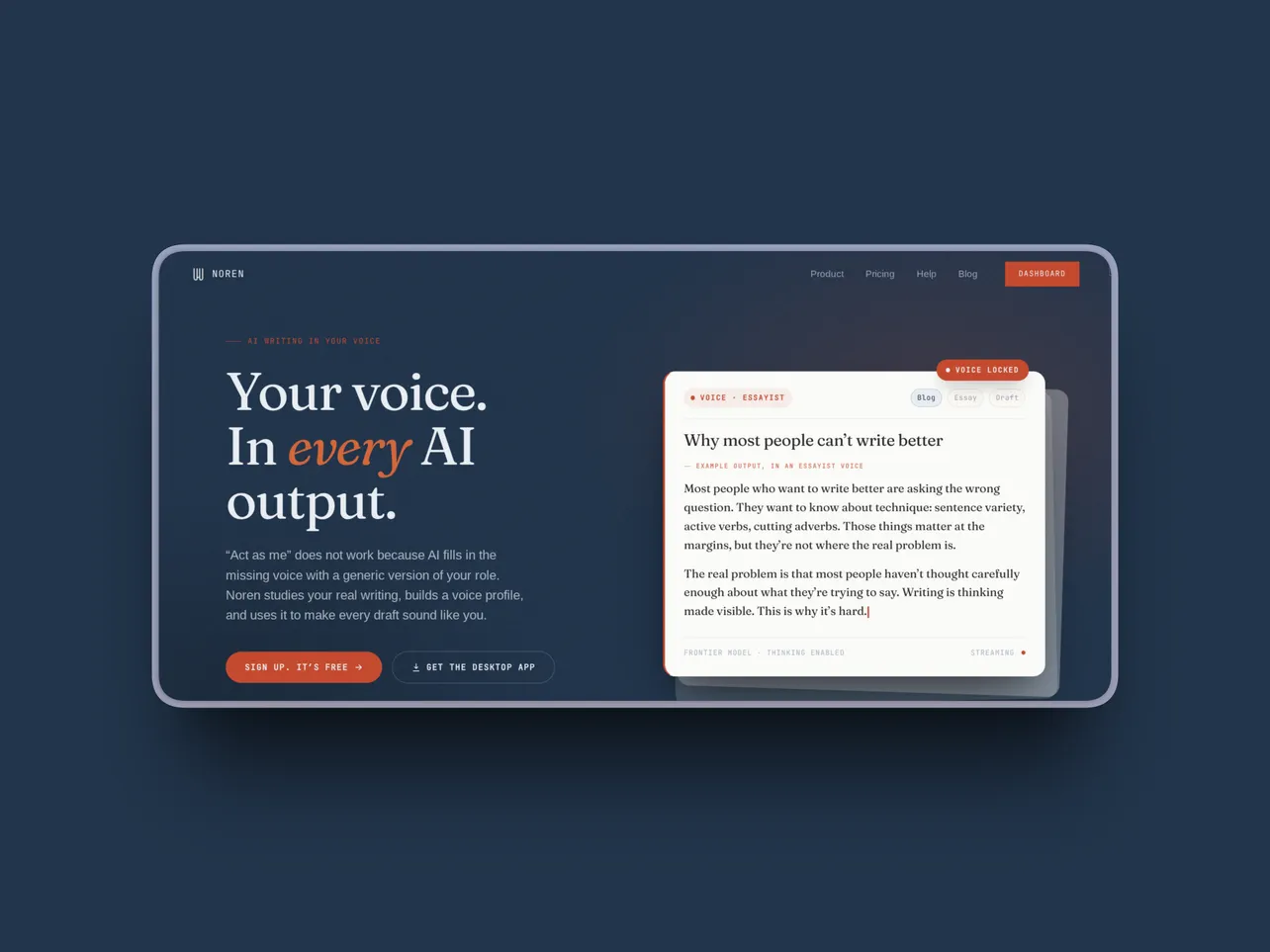
Merriam-Webster's 2025 Word of the Year was "slop". That's the backdrop Wilfred and Onome Okajevo built Noren against: a feed that's become measurably more uniform as more people lean on AI to write, and a category of tools that have got better at fluency while getting worse at preserving the person doing the writing.
Noren is a voice extraction engine. You feed it samples of your real writing, it builds a structured profile of how you actually write, and that profile can be used with Claude, ChatGPT, Gemini, or any model that takes instructions. The output stops drifting toward the statistical median and starts sounding like you.
That's the simple version. The interesting version is why two brothers, one with a research background in how humans think and communicate, the other with seven years building distributed financial systems, decided this was the problem worth a year of their lives.
The Brothers Building Noren
Noren has two cofounders, and they're brothers.
Wilfred Okajevo leads the ML and cognitive-science side of the product. His background is in building systems that understand how humans think and communicate, which is the lens behind Noren's voice extraction engine.
Onome Okajevo brings the operator side. He's an MD turned builder with seven-plus years building distributed financial applications, and he's spent a lot of time thinking about systems, risk, mechanisms, and how things fail in the real world.
That mix shaped the product. Wilfred's description of it:
"It is a technical product, but the problem is deeply human: how do you let people use AI without slowly sanding away the identity in their writing?"
You can see that split in the product itself. The extraction engine is research-heavy and structural. The way Noren positions itself, sits next to other tools rather than trying to replace them, and ships across macOS and Chrome is the operator instinct showing up in product decisions.
The Diagnosis
If you've spent any time on LinkedIn in the last two years, you'll recognise the pattern Wilfred describes. Three posts about building a company that all feel like one long post. Competent writing, properly punctuated, full of "robust" and "pivotal" and "facilitate", and somehow forgettable five minutes later.
His framing in The Homogeneous Feed:
"When AI writes without a voice profile, it draws from the same statistical defaults across every tool and every user. The result is a feed where a thousand different people sound like one generic voice."
The cause, in his framing, is mechanical rather than cultural. AI writing assistants don't have a voice. They have a distribution. A probability-weighted vocabulary trained on formal professional text, with sentence rhythms that cluster around the same 15-to-25-word range, regardless of who's prompting it.
The collective effect emerges from individual rational choices. Each writer has things to say and limited time. Each one reaches for the tool that speeds production. The output of any one writer looks fine. The output across thousands converges.
The Moment It Clicked
The trigger for Noren, in Wilfred's words, was realising that "write like me" was being treated as a prompt problem.
The brothers did what most people do first. They looked at samples, wrote rules, described tone, tested outputs, and adjusted prompts. The outputs got cleaner without getting more like the person.
So they went manual.
They spent weeks documenting how people write by hand. Sentence rhythms, word choices, where analogies came from, how arguments were sequenced, which transitions a person avoided, what punctuation felt wrong for them. Hundreds of lines of logic. That was how they built their first voice profile, by hand, with no extraction engine yet.
The moment it clicked was when that deeper profile made the output finally sound right. Not because the model got a better adjective like "professional" or "conversational", but because it had a more structural map of the writer.
That reframed the problem. In Wilfred's own words:
"It was not 'write a better prompt.' It was 'extract the identity layer from real writing and make it reusable.'"
Around the same time, the brothers were watching the feed itself change. More posts were competent, fewer had edges. Different people were starting to sound like the same person using the same model defaults. That observation became The Homogeneous Feed, and it became part of the case for building Noren as a category rather than a feature.
The Lane Noren Picked
The AI writing space already has plenty of products. Jasper for brand voice. Sudowrite for fiction. Grammarly for editing. Every model lab is shipping a writing feature of some kind.
Noren picked a smaller lane on purpose: personal voice, extracted from real samples rather than described in a prompt.
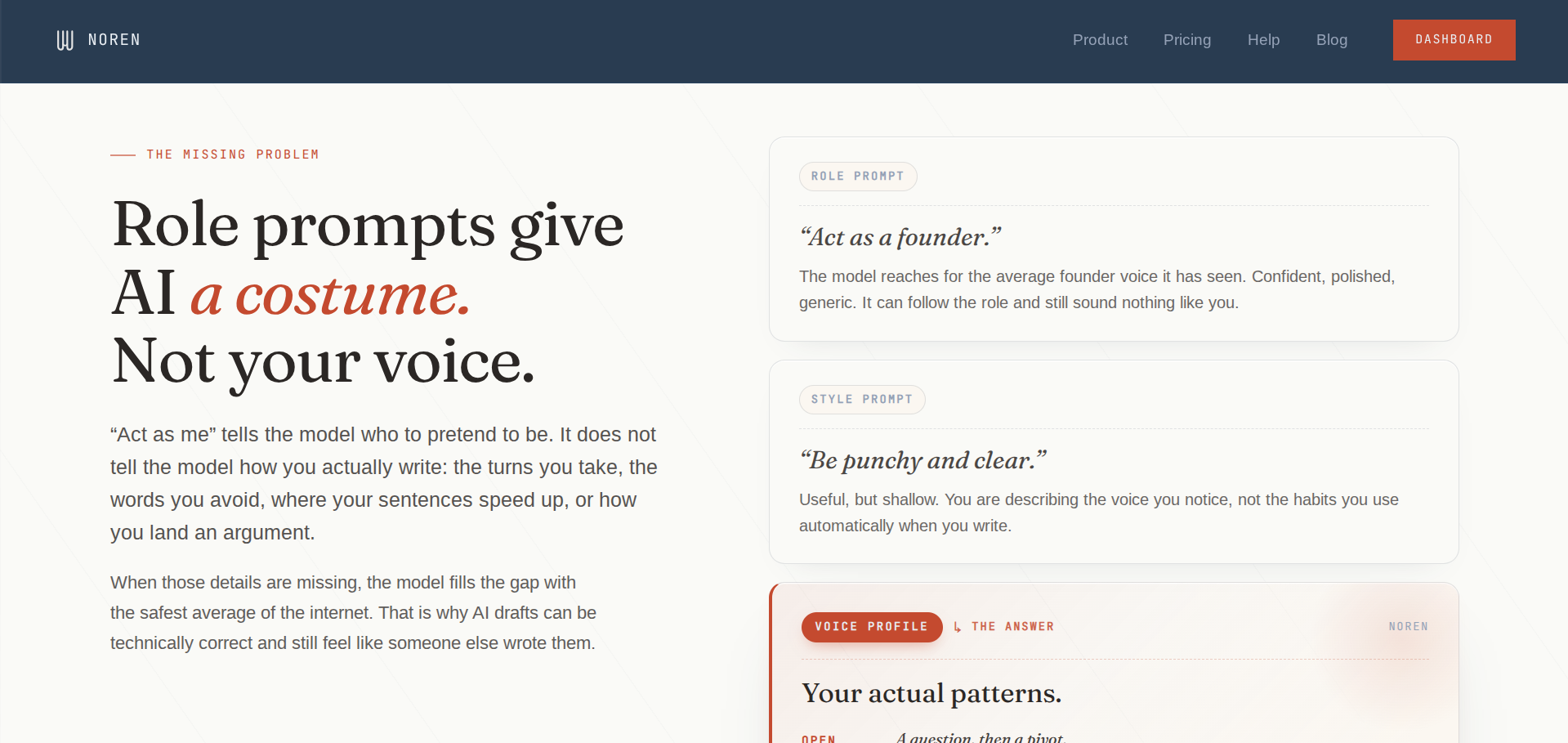
The distinction matters. A tone instruction is surface-level and per-task. You tell the model to "write in a casual, conversational tone" and it gives you something casual and conversational, but it's the model's idea of casual, not yours.
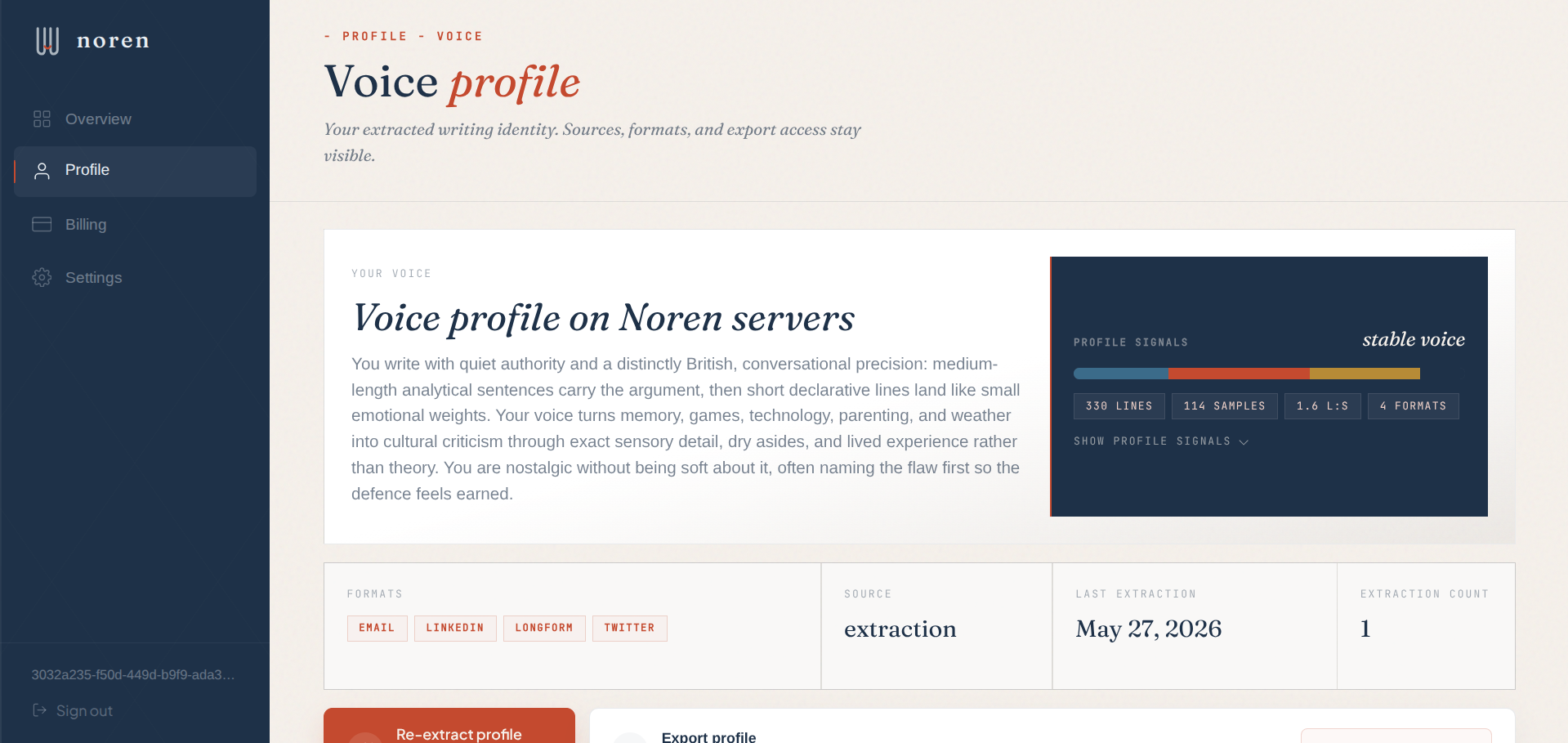
A voice profile is structural and persistent. It captures the analogy domains you reach for, the rhythm of your sentences, the way you tend to open an argument. It captures habits you couldn't put into words if asked, because they're too automatic to notice.
The profile is output as plain Markdown. That means it's portable, inspectable, and not locked into any one app. You can use it with Claude today, ChatGPT tomorrow, and whatever ships next month, without rebuilding it from scratch.
What Noren Doesn't Do
One of the cleaner things about how the brothers talk about Noren is what it explicitly isn't.
It isn't supplying the idea. It isn't writing the argument. It isn't generating facts or judgment. The profile only carries how you write: the words you reach for, how you open and close, the rhythm of how you structure a point. The brief still carries what you actually want to say.
That separation is doing a lot of work. It's why Noren can sit next to a model rather than try to replace it. It's why the same profile works across any LLM that accepts instructions. The profile is the persistent layer. The model handles the generation.
It's also a useful product position commercially. The brothers aren't competing with the model labs. They're selling a layer that makes the labs' outputs less interchangeable.
The Bet
The bet behind Noren, in Wilfred's framing, is that voice is structural rather than tonal, and that identity becomes more valuable as fluent writing gets cheaper.
Most AI writing tools chase fluency, speed, and volume. That creates a world where everyone's writing gets pulled toward the same average. The better the models get, the cheaper fluent writing gets, and the more obvious the homogeneity problem becomes.
Most people disagree with that bet implicitly. The default assumption is that better models will solve the voice problem on their own, eventually. The Okajevo brothers think the opposite. Better models make the voice problem more visible, because generic fluency will be everywhere.
There's a story Wilfred keeps coming back to, and it's the one that explains the whole project better than any product description would.
"After Emily Dickinson died, her poems were edited to make them more presentable. Her dashes were removed, her capitalization was normalized, words were changed, titles were invented. The parts that made her strange and singular were treated like mistakes. Then, much later, the closer versions of her work were restored, and the world could see the real force of her voice."
The same instinct shows up with AI writing. Smooth the rough edges. Normalize the rhythm. Make it sound more professional. Sometimes the so-called rough edges are the voice.
That's the future the brothers are building toward. The user still brings the idea, argument, facts, examples, and judgment. Noren carries the layer underneath: rhythm, structure, recurring moves, anti-patterns, and the small habits that make someone's writing feel like theirs.
Where Noren Goes From Here
Noren is early. Small team, free tier, available on macOS as a download and as a Chrome extension. Pricing is published. The voice profile output is in plain Markdown, which means it's portable, inspectable, and not locked into any one app.
The product roadmap is less about features and more about coverage. Anywhere a person writes through an AI tool, the profile should travel with them.
The deeper bet is on the category. Whether "voice profile" becomes a standard layer that sits between people and models, the way style sheets sit between content and presentation, is the question the Okajevo brothers are effectively betting their time on.
It's an interesting bet. The product is genuinely different from what's around it. The thesis is sharp enough to disagree with. And the founders are doing the kind of focused, research-led work that tends to produce a real category rather than a feature.
Where to Find Noren
- Company: usenoren.ai
- Sample voice profile: usenoren.ai/sample-voice-profile
- Blog: usenoren.ai/blog
- Wilfred on X: @prokajevo
- Wilfred on LinkedIn: Wilfred Okajevo
- Noren on X: @usenoren
- Noren on LinkedIn: Noren