

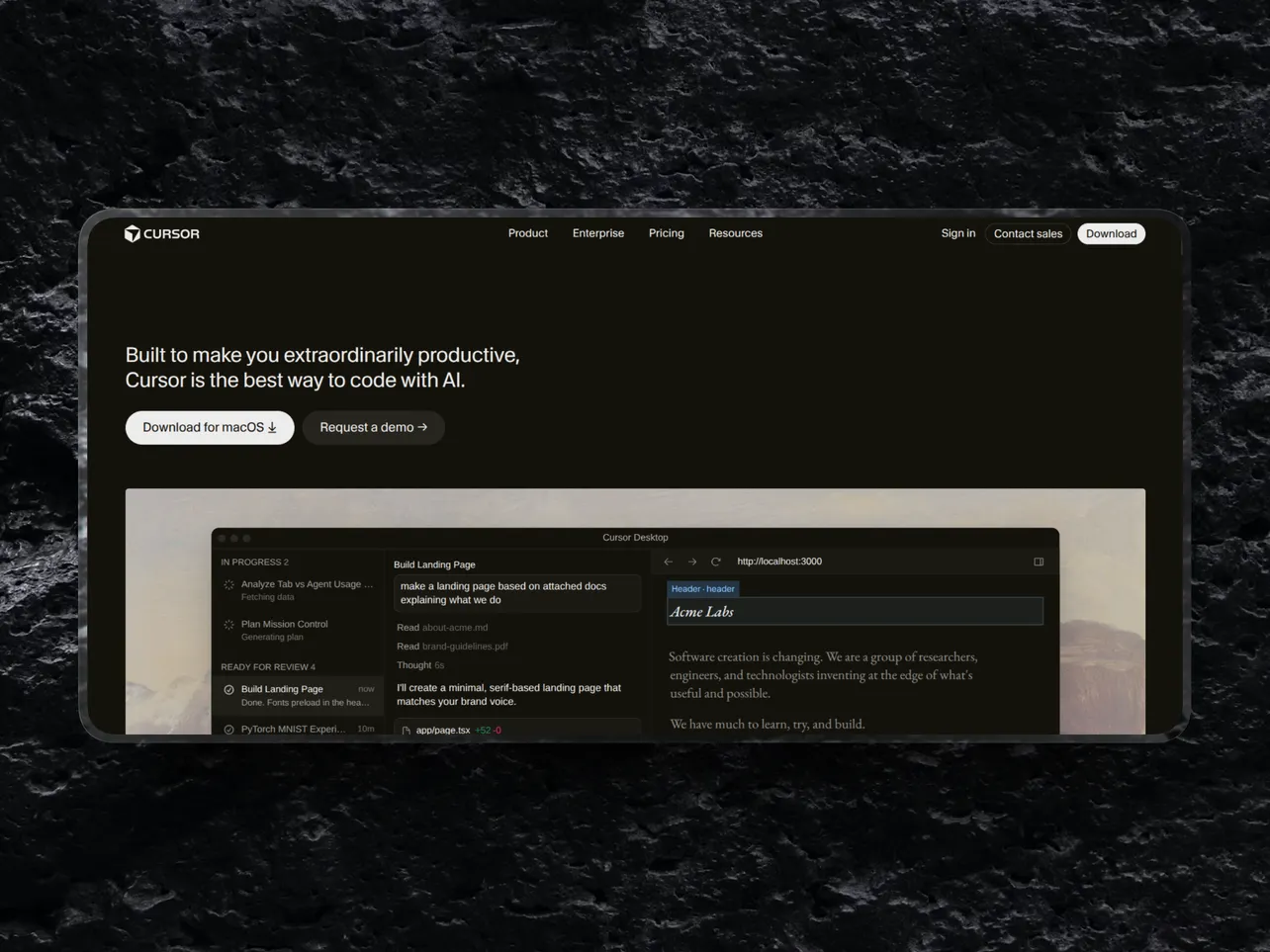
Cursor shipped its biggest release to date on the 2nd of April, and the headline isn't a faster autocomplete or a new model.
It's that the IDE, the thing the company spent two years building a fork of VS Code around, has been demoted. The agent management console is now the front door. The editor is what you open when an agent needs babysitting.
That's a pretty bold call for a company reportedly chasing a $50 billion valuation, so it's worth picking apart what's actually in the release and why they've made the bet they have.
What Cursor 3 actually is
Cursor co-founders Michael Truell and Sualeh Asif describe it as "a unified workspace for building software with agents".
In practice that means when you open Cursor 3, you don't land on a file tree. You land on a sidebar listing every agent you've got running, whether you kicked them off from the desktop, from mobile, from Slack, from GitHub, or from Linear.
They all appear in one place. The interface was built from scratch under the codename Glass, rather than being another layer bolted on top of the VS Code fork.
 Chris Kernaghan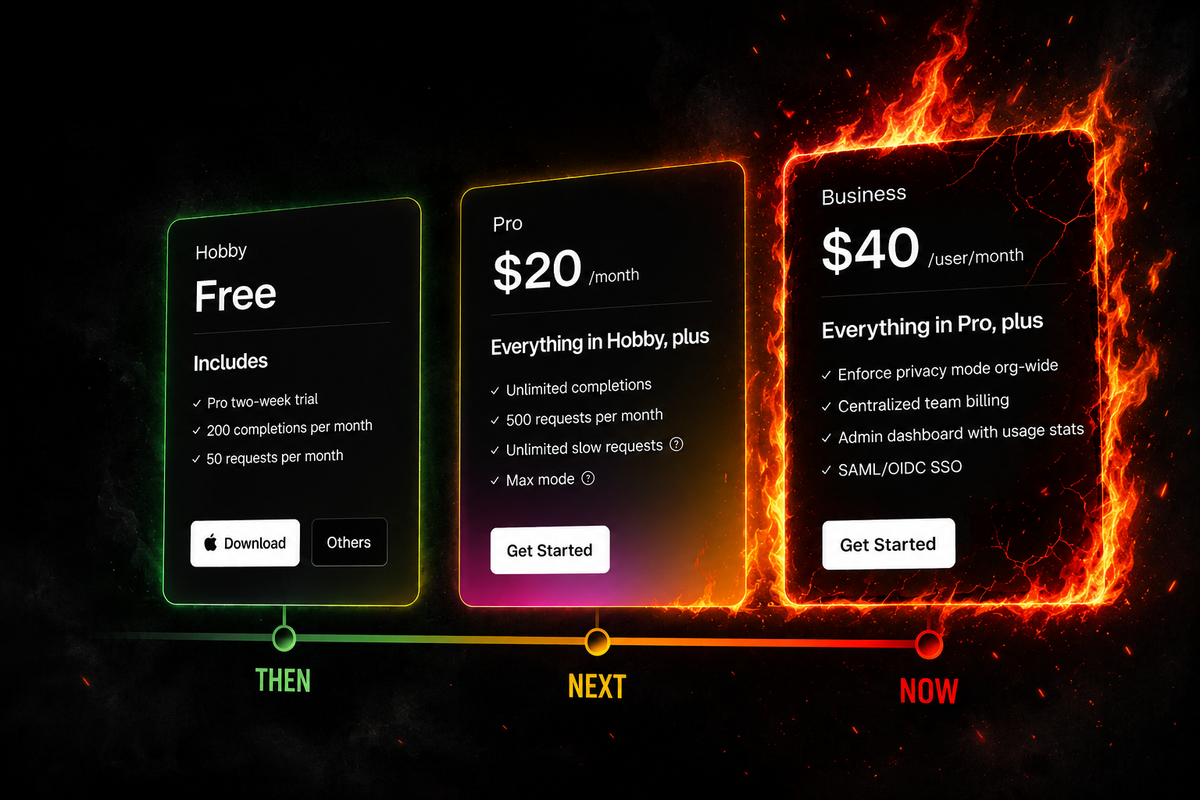
The pitch is that engineers are spending too much time micromanaging individual agents, juggling terminals, and tab-switching between conversations. Cursor's argument is that the surface needs to change to match how the work has changed.
Whether you agree with that framing or not, it's a fairly honest read of how a lot of people are actually using these tools now.
The features that matter, in plain terms:
- Parallel agents. Cloud agents run alongside local ones and produce demos and screenshots, so you can verify the work without pulling the branch and running it yourself.
- Cloud-to-local handoff (and back). You can move an agent session between environments in either direction. Genuinely useful if you've ever started something on your laptop, closed the lid for a meeting, and lost the thread.
- New diffs view. Meant to take you from commit to merged PR without leaving the agent surface.
- Cursor Marketplace. Plugins built around MCPs, skills, and subagents, with one-click install and the option to spin up a private team marketplace.
The classic Cursor stuff is still there. Files. Go-to-definition. Full LSPs. The integrated browser for prompting against local sites. You can switch back to the IDE view whenever you want. But the default has moved, and that's the point.
Why they're doing this now
The release didn't happen in a vacuum. Cursor's been under a different kind of pressure for most of the last twelve months, and most of it has Anthropic's name on it.
Claude Code, which launched as a terminal-first tool roughly a year ago, has reportedly hit a $2.5 billion run rate with over 300,000 business customers. Fortune ran a piece earlier this year quoting one Cursor investor saying several of his portfolio startups had decoupled from Cursor entirely.
The vibe shifted. Developers started posting publicly about switching to Claude Code. That's not the kind of momentum you ignore when you're trying to close a fifty-billion-dollar round.
Then there was the pricing mess.
In June 2025 Cursor swapped its request-based model for a credit-based one, where the cost of any given action depends on which model you're using, how long your context is, and how many tool calls happen.
 Mia Jones
The Pro plan went from delivering around 500 Claude requests a month to roughly 225. Reddit and Medium filled up with users describing the credit counter as anxiety-inducing.
The CEO apologised and issued refunds. The trust damage stuck.
Cursor's response over the last three months has been to ship aggressively. Automations launched on the 5th of March, letting agents trigger from GitHub events, Slack messages, and timers without anyone in the loop.
The architectural disagreement underneath
If you zoom out, every major AI coding tool now agrees that agents need a dedicated orchestration layer. What they disagree on is where it lives.
Anthropic went terminal-first with Claude Code and treats the CLI as the centre of gravity. OpenAI spread Codex across a desktop app, a CLI, an IDE extension, and a web interface, betting that orchestration should be everywhere. Cursor 3 puts the orchestration layer inside what used to be the editor, and demotes the editor to a side panel. Three companies, three answers.
That's the interesting bit for founders watching the category.
It's not really about which IDE is fastest any more. It's about who owns the surface where you decide what work gets done. Cursor's bet is that developers will pay for the place they manage their fleet of agents, not the place they type code.
What it means if you actually use Cursor
If you've been on Cursor through the pricing changes and you're wondering whether to upgrade, the practical answer is fairly boring. The IDE still works. You can still write code the way you did last week. Cmd+Shift+P, type Agents Window, and you'll get the new interface. Type your way back to the editor whenever you want.
The honest question is whether the agent-first workflow actually fits how you work. If you're already running multiple cloud agents, handing off tasks from Linear, and reviewing PRs more than you're writing code, Cursor 3 will probably feel like a relief. If you're mostly doing focused solo work in one repo, the new surface is going to feel like overhead.
There's also a quieter trade-off worth flagging. Cursor's whole pitch with Cursor 3 is that the work has moved up a level of abstraction, and the tool should reflect that.
So is this the moment?
Probably not the moment, no. It's a moment.
Cursor 3 is a real product change, not a marketing refresh, and the bet underneath it is coherent even if you don't buy it. Whether it pulls developers back from Claude Code, or whether it gives the next funding round a story to tell, is something we'll have a clearer view of by the summer.
What it does tell you is that the AI coding category has stopped competing on autocomplete and started competing on where you stand when you decide what gets built. That's a more interesting fight, and Cursor's just made its opening move.