Ask ChatGPT and Claude the same question and they'll both answer with the same confidence, whether they're right or not.
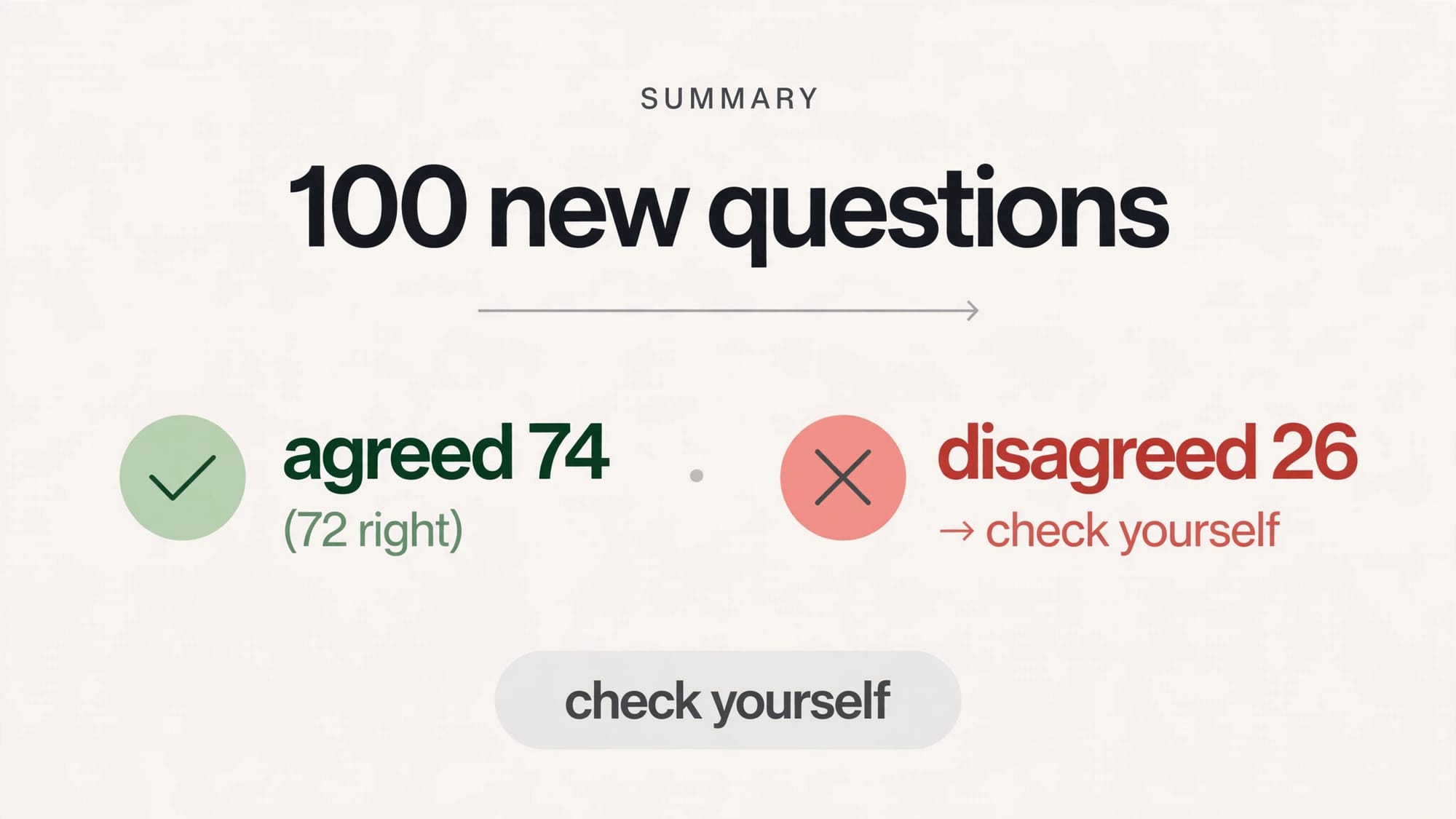
Vadym Chernets, an AI researcher based in New York, studies when you can actually trust an AI's answer, and two of his papers on it were accepted at NeurIPS 2026 workshops (one, two). In his own run of 100 new questions this October, the two models agreed 74 times and were right in 72 of those, and disagreed on the other 26.
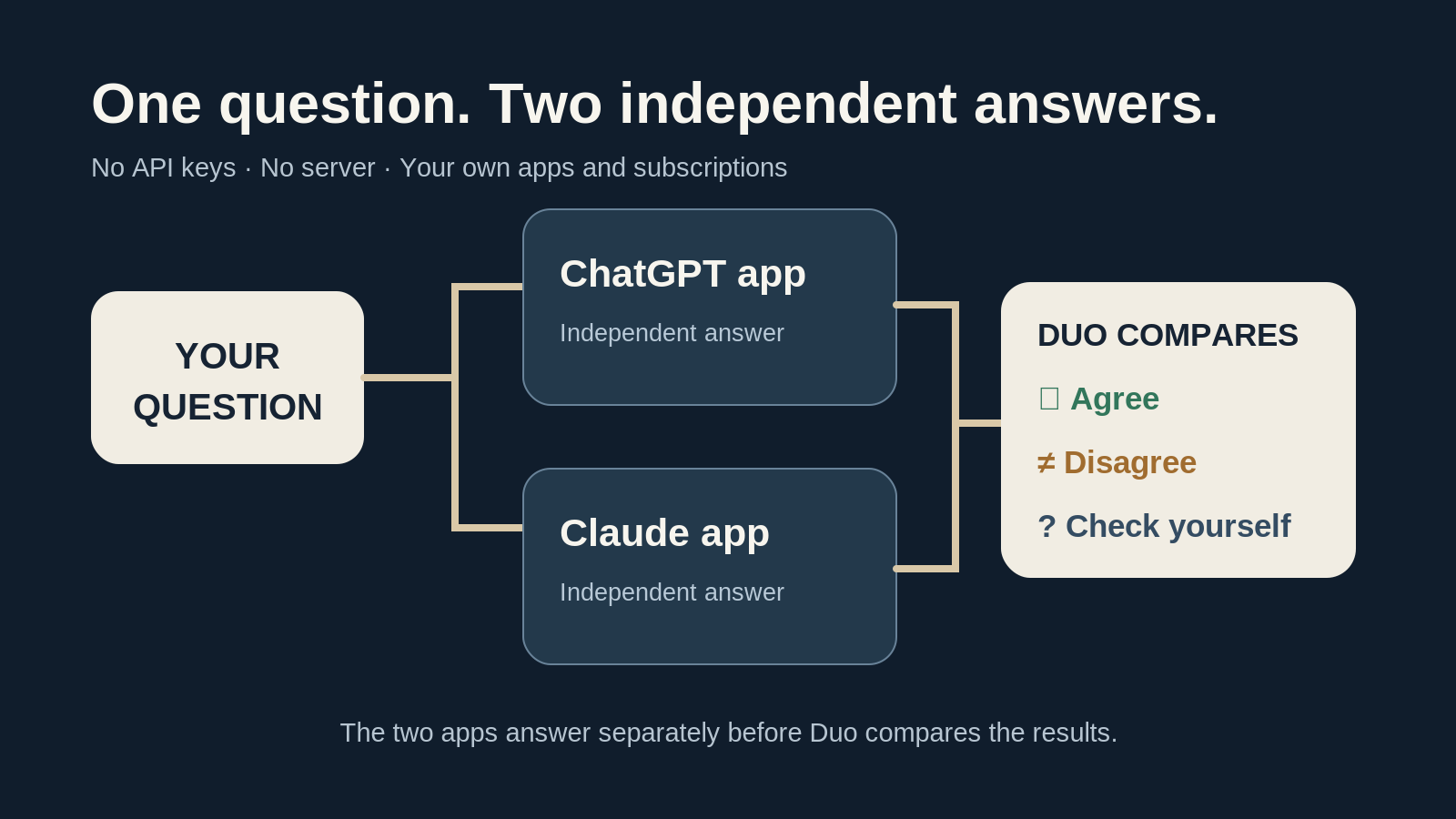
That gap is what Poly Duo is built around. It's a free, open-source iPhone Shortcut from his company, PolyHelper, that sends one question to the ChatGPT and Claude apps separately, on your own accounts, then shows you where they agree, where they differ and what's worth checking yourself. There's no server, no API key and no cost, and it started life as an accessibility tool.
In this Q&A, Vadym explains why one tap matters so much for people with limited mobility, how two apps he doesn't own were made to work together, why ChatGPT now sends people to his site every day, and why he'd start with teachers if he did it again.
Who are you, and what are you building?
I'm Vadym Chernets, PhD, an AI researcher based in New York. One of the questions I study is when you can trust an AI's answer; two of my papers on it were accepted at NeurIPS 2026 workshops this year. Poly Duo is a free iPhone Shortcut: you ask a question once, and ChatGPT and Claude each answer it independently, in their own apps and on your own accounts, free or paid.
Poly Duo then shows you where they agree, where they differ and what's worth checking yourself. It costs nothing, needs no API keys and no server of ours, and the code is open source.
Why two models: in October I tested the latest popular models again on 100 new questions I'd never published anywhere. GPT-6.1 Sol and Claude Opus 5.5 agreed 74 times and were right in 72 of them. On the other 26 they disagreed, and that's exactly where it pays to check for yourself.
Where did the idea come from, and what tipped you into actually building it?
Poly Duo started as an accessibility tool. To compare two AIs you have to copy the question, switch apps, paste, scroll and copy again. For someone with sore hands, a bad back or poor eyesight, that's slow and tiring. My son was in an accident and has metal implants in his body.
We wanted to get rid of all that hassle: one tap, both models answer, and the result sits on one screen (there's audio too). Then the same thing happened as with a dropped kerb: it was built for wheelchairs, and now everyone uses it, with a suitcase, a bike or a pram. Poly Duo is the same: anyone who wants to double-check an AI can use it.
And it's worth comparing. A model sounds just as confident when it's right as when it's wrong. This summer I ran a small experiment with 133 people, 79 of them in the UK.
Showing them where the models disagree clearly reduced how willing they were to accept confident but wrong AI advice: on the most telling question, from 74% to 24% (an early result). It's a live issue in Britain too: in a YouGov survey for ACI Worldwide in June, 69% of UK adults said they don't trust AI agents with shopping and payments, even when the agents follow rules the person set themselves.
What did shipping the first version actually take?
The main job was getting two apps we don't own to work together without a single server, without keys, and without us ever seeing your questions or answers. On iOS you can do that with Shortcuts: Poly Duo hands the question to the ChatGPT app, then to Claude, separately, so the answers don't influence each other, and brings both answers together on one screen.
The hard part: Shortcuts can't choose the model. ChatGPT runs in auto mode on the user's plan, and Claude answers with the app's default model. So Poly Duo compares what people actually have on their phones, not a lab setup.
The best ideas came from people. A member of the German KI Forum suggested flagging, in the final answer, the values where the AIs disagreed. Take a medicine question: one AI says "every 4 to 6 hours", the other says "6 to 8". That's exactly the moment you want to see they differ and check the label, and now you can see it even if you only read the summary.
We're also noticing that AI is blurring the line between programmers and non-programmers. People who don't even know what GitHub is are now using open source, including Poly Duo, which is available in 12 languages.
How did you get your first users, and what has moved the needle since?
We started on 25 October where Shortcuts fans live: RoutineHub, where a moderator replied "Nice work!". After that Poly Duo got another 50 downloads there, and this month someone wrote "looks cool".
Poly Duo also brought our first research collaboration: Mark Goodbody, a systems engineer in the UK, found us himself and shared cases from his Mechanical Ethics work, and we're comparing two dependency maps of the same case to see where they differ (polyhelper.ai/goodbody/).
In our site analytics we've seen ChatGPT and other AIs sending people to us every day. People ask their AI a question, it tells them about Poly Duo and gives them a link to our site.
Programmers mostly missed us, because they orchestrate AIs through the command line on a computer. Poly Duo was noticed by ordinary people who don't know what GitHub is and use a smartphone.
Duo is free and open source, so how does it fit into PolyHelper as a business, and where are you now?
Our team's speciality is giving people easy tools for orchestrating, or combining, several AI models. Our commercial app, Poly, helps an ordinary person quickly learn to run several AIs together, and a lot of it is free too. Poly Duo connects two leading AI models on a smartphone; it isn't a business, but it's a real joy to see people getting value from it for free.
Last month we also launched a commercial project on our site, Money (polyhelper.ai/money). More than ten leading AIs follow how money moves around the world every day and show people where they agree and where they differ on money, investing and markets.
And on 19 March, London: I'm speaking at ISC2027 (British Blockchain Association). The talk is about the same idea that sits under Poly Duo: we gave 14 of the world's leading AIs a virtual $100,000 each and watch where their decisions diverge and what of that can be checked.
What has been the hardest part, and what would you do differently if you started again tomorrow?
Technically, one last hurdle is left: the first run. The first time, iOS asks you to confirm a series of permissions by hand: allow the shortcut to pass the question to ChatGPT, to Claude, and so on. Most people tap "Allow" a few times once in their life and forget about it. But for someone with limited mobility, the person Poly Duo was designed for, that's exactly the barrier we wanted to remove.
We've cut everything we can on our side; the rest is in Apple's hands, and on Android in Google's. I've been raising this with both companies since 2025, because for people with limited mobility those few taps are the whole barrier. Poly Duo can work on Android too, but there are even more manual steps there.
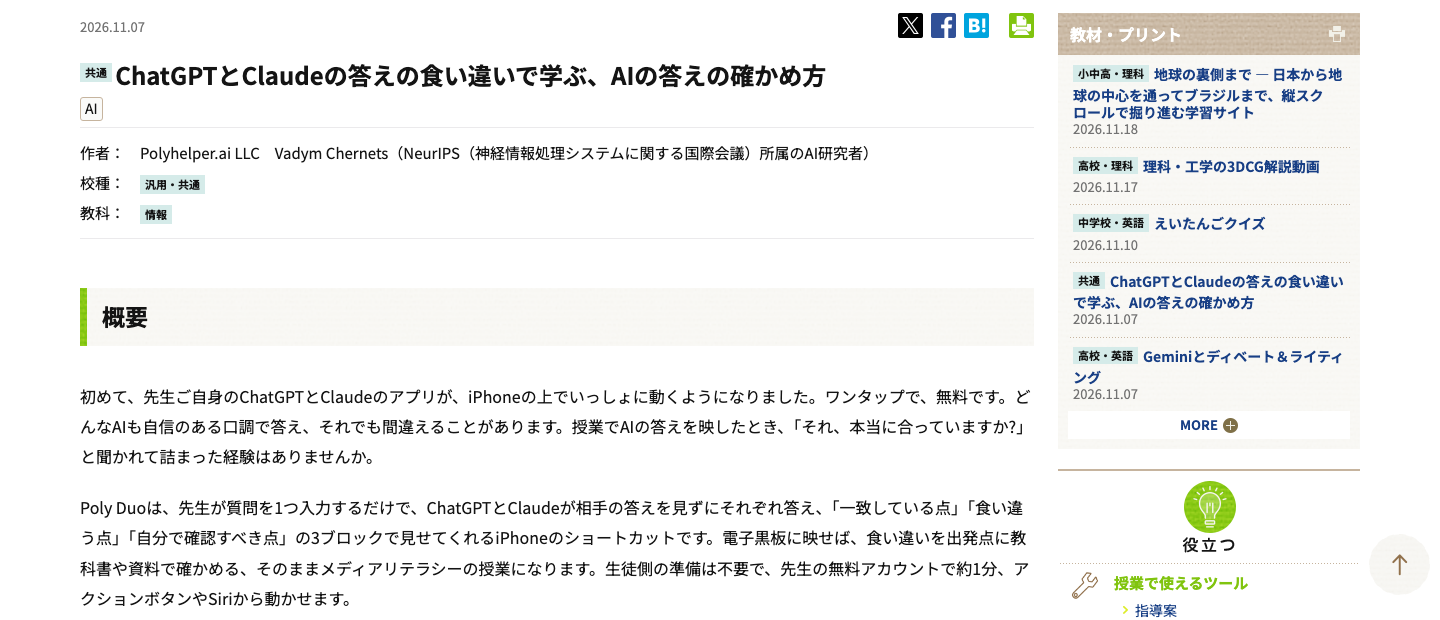
What would I do differently if I started tomorrow? I'd start with teachers straight away. Teachers like Poly Duo. The OER Commons team (ISKME) suggested a lesson, I wrote "Ask two AIs the same question: find where they disagree", and they added it to their collection. It was also published by Manabi no Ba, a Tokyo portal for teachers (Uchida Yoko Institute for Education Research).
Which founders do you watch or learn from, and what's next for Poly Duo?
Two founders I keep coming back to are Demis Hassabis and Dario Amodei. Hassabis built DeepMind in London and spent years on protein folding, a problem most people thought was decades away; AlphaFold, and later a Nobel Prize, came from patience rather than hype. Amodei left one of the most successful AI labs to start Anthropic with safety at its centre. That's the founder's paradox I recognise: you need enough confidence to build, and enough doubt to keep checking your own work. Poly Duo is that doubt, built into one tap.
What's next: work that will make Poly Duo easier both for people with disabilities and for everyone else. First, a fully hands-free run: Siri can already start Poly Duo, and next the whole cycle should work by voice, with both answers read back to you. Second, a first run with no manual confirmations.
On iPhone, OpenAI and Anthropic opened the door themselves: their apps offer "Ask ChatGPT" and "Ask Claude" actions that Poly Duo can call. On Android that door isn't open yet. Android has its own version, AppFunctions, but ChatGPT and Claude don't offer a function like that through it, so the next step is theirs and Google's.
What to take from Vadym's story
The lesson most founders can use is the one Vadym calls the dropped kerb. He designed Poly Duo for people who find a few extra taps genuinely hard, and that discipline produced something simpler for everyone, down to treating a handful of iOS permission prompts as a problem worth raising with Apple and Google. If you build for your most constrained user, the product usually gets better for the rest.
The other point worth noting is where his users came from. Programmers mostly missed Poly Duo, while ordinary smartphone users found it, partly because ChatGPT and other AI assistants now send people to his site every day. If AI recommendations are starting to drive your traffic too, our Q&A with the founder of Brand MRI, a tool that checks how AI assistants see your brand, is a good next read.
Want to try it? You can find Poly Duo at polyhelper.ai/duo.
Have a story of your own? Share your founder story and we'll feature it.