

Every December, feeds fill up with Spotify and Strava recaps, and each one doubles as a free advert for the app behind it. Róbert N, who builds small products on the side of his day job in Iceland, wondered why smaller apps don't get the same thing, and built Yearcap to find out.
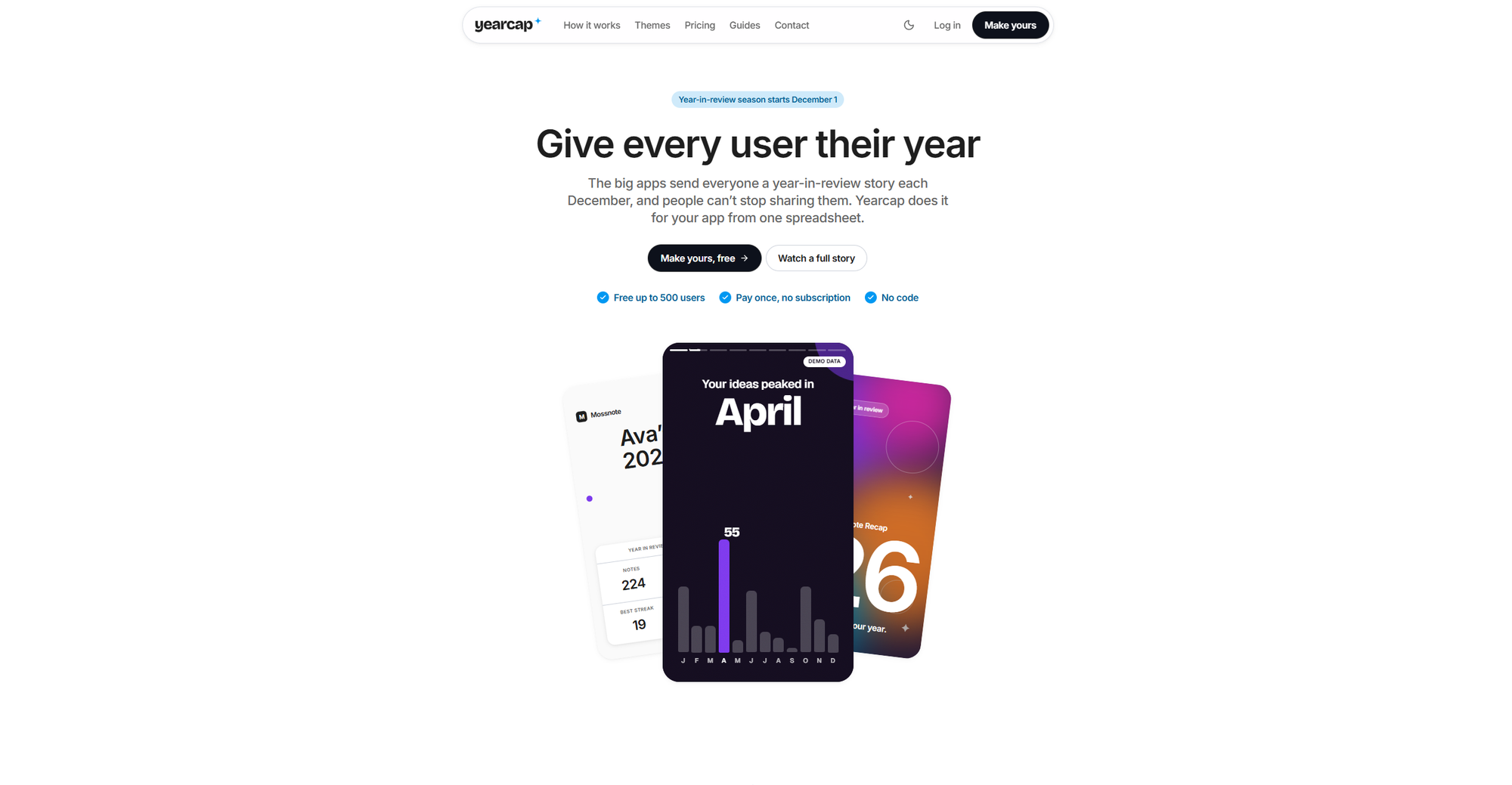
An app uploads one spreadsheet of its users' stats, and every user gets a short story about their year, ending in a share card that links back to the app. It's a one-time payment per campaign, with a free tier for small audiences, and he's candid that there's no revenue yet.
In this Q&A, Róbert explains how he built it in two to three weeks of evenings, what happened when he emailed around 80 apps in November, why teams plan their December features in September, and how the data is handled.
1. Who are you, and what are you building?
I'm Róbert, I live in Iceland and build small products on the side of my day job. Yearcap gives small apps the kind of year-in-review Spotify and Strava do every December. An app uploads one spreadsheet of its users' stats, and every user gets their own short story about their year, ending in a card they can share that links back to the app.
2. Where did the idea come from, and what tipped you into actually building it?
Every December my feed fills up with people sharing their Spotify and Strava recaps, and those shares are basically free ads for those apps. Small apps have the same data but no team to build something like that. Once I saw that the whole thing could run off one spreadsheet, with no code on the app's side, I wanted to see if I could make it.
3. What did shipping the first version actually take?
About 2-3 weeks of evenings after work to get it polished and fully ready. Along the way I added a small side project on top of it: anyone can type a GitHub username at yearcap.co/github and get their own 2026 on GitHub as a story, which doubles as a live demo. I built it with Next.js, Vercel, Postgres and Claude Code, with Polar for payments and Resend for emails. Costs so far are small: a domain, hosting on free tiers, and an AI subscription I already had.
[Screenshot placeholder: The yearcap.co/github page showing a GitHub username's 2026 story]
4. How did you get your first users, and what has moved the needle since?
Still early. I emailed around 80 apps, each with a demo story made for their app. About a third opened theirs, and some keep coming back to it, so people are trying it out, but no app has sent stories to its own users yet. The most common pushback is "we already have our own" or "our data stays on the phone." Short videos and directory listings bring visitors, and the demo is where they spend their time.
5. How does it make money, and where are you now?
It's a one-time payment per year: free up to 500 users, $49 up to 10,000 and $149 up to 100,000. No revenue yet. December is the season, so the next few weeks decide a lot.
6. What has been the hardest part, and what would you do differently if you started again tomorrow?
Timing. Teams plan their December features in September, and I started reaching out in November. If I started again, I'd launch in the summer and go after small teams where the person who decides reads the email, not a support inbox.
On data: the app decides what goes in the spreadsheet, and Yearcap only uses it to make the stories. The AI that writes the story cards only sees column names and number ranges, never a user's row. Every user's data is deleted automatically 90 days after the campaign goes live, or right away if the app deletes it. If an app asks Yearcap to email its users, each user gets one email with their story link, and anyone can unsubscribe.
7. Which founders do you watch or learn from, and what's next for Yearcap?
No famous names, honestly. One of my closest friends builds a lot of his own projects, and he is the one who got me into making things. Watching him ship is what made me start. Next is getting the first few apps to send stories this December. I'm offering to set it up for free from their export, so the first users can see it working with real data.
What to take from Róbert's story
Two lessons stand out even if you never build for a seasonal moment.
The first is his habit of sending each app a demo made with its own data instead of a generic pitch, which fits what we heard from Chukwuezugo Aronu of Build n Booked on why a targeted list beats a loose one.
The second is the timing point: if your buyers plan their year months before the moment you're selling to, the real deadline is much earlier than the season itself. If you're building your own outreach, our guide to the best cold email tools for founders is a useful companion.
Want to try Yearcap? You can find it at yearcap.co, and you can see your own year on GitHub at yearcap.co/github.