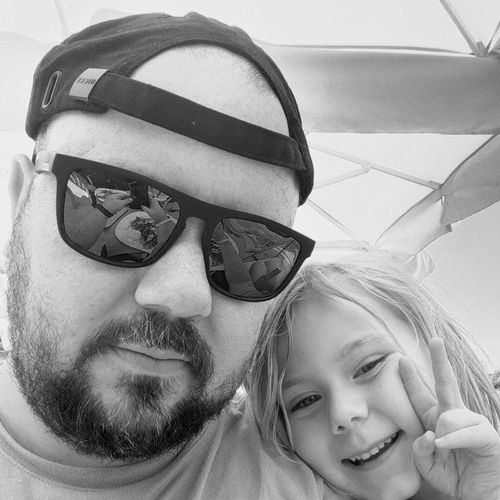

Building an app used to take a team and a pile of cash. Amit Shabtay built Dailies at home with his son on a £90-a-month Claude subscription, and he's refreshingly frank about which half of the job turned out to be harder.
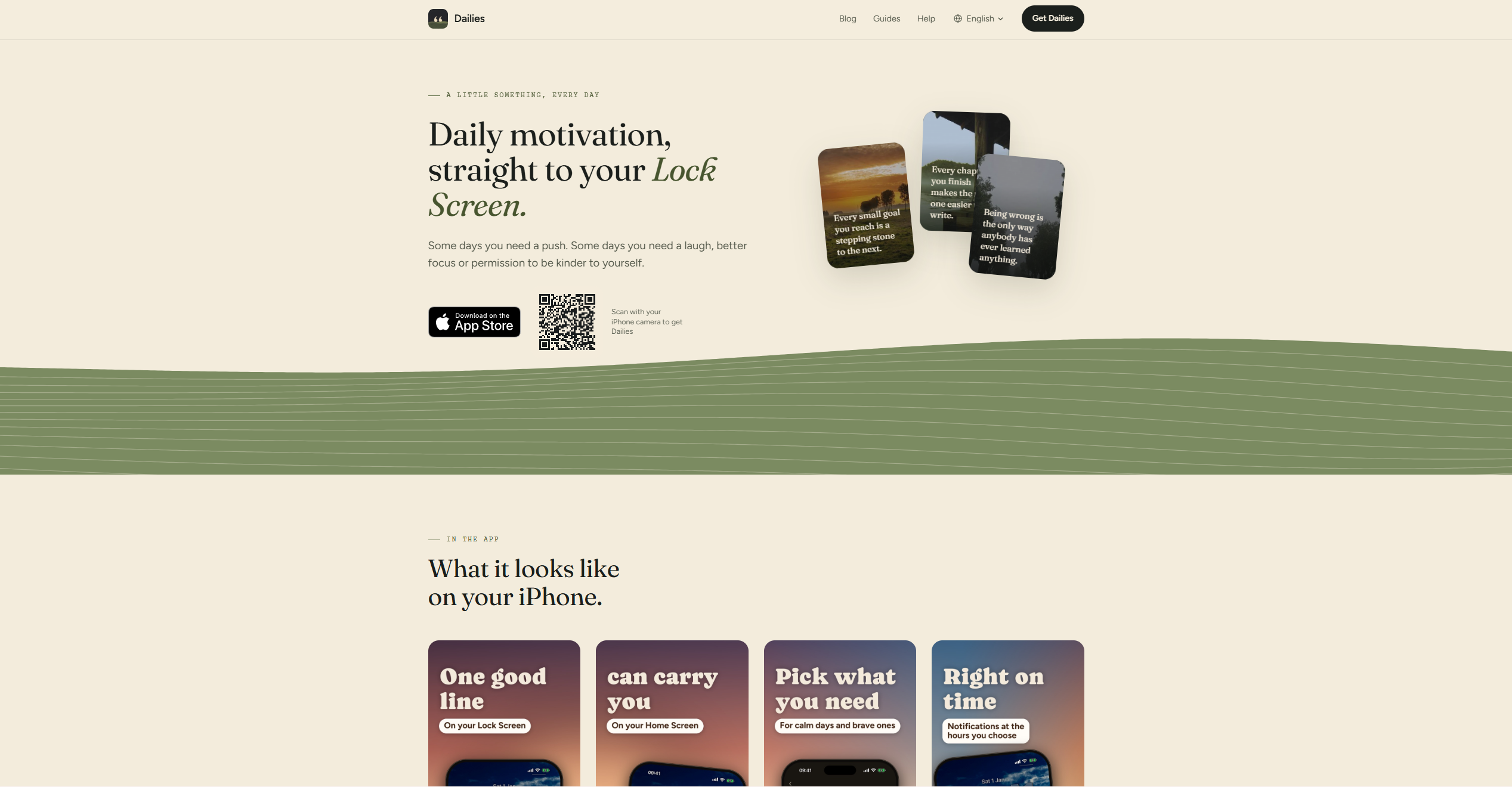
Amit was part of the team behind Facetune and built Enlight and Photoleap, which he says won an Apple Design Award in 2017 and reached 1 million monthly active users respectively, so he's seen a big consumer app from the inside. Dailies, which he launched in early October 2026, is a much smaller thing by design: it sends motivational quotes to your Lock Screen and Home Screen, so you never have to open the app at all.
In this Q&A, Amit explains how he built three or four features a day and killed nearly all of them, why Apple Search Ads in Latin America delivered cheap installs and no paying subscribers, how ChatGPT became a quarter of his organic downloads without him doing anything to earn it, and why he'd now spend 80% of his time on marketing.
1. Who are you, and what are you building?
I'm Amit Shabtay, the co-founder of Dailies, building it with my son. In the past, I was part of the team that built Facetune. I've also built Enlight, a photo editing app that won an Apple Design Award (2017) and Photoleap, the next generation of editing photos on your phone, that reached 1M MAUs.
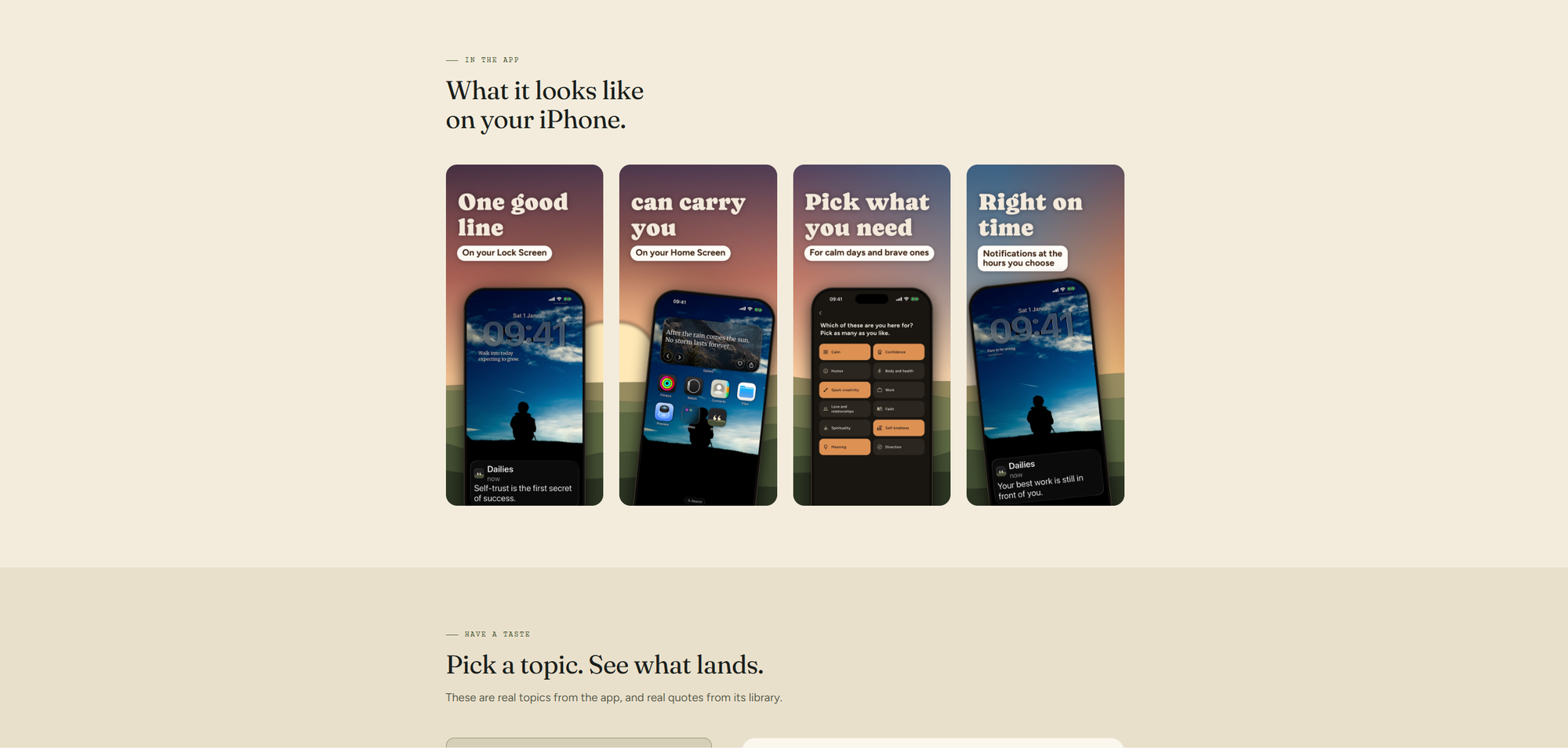
Dailies sends motivational quotes to your Lock Screen and Home Screen, so the right words find you during the day. Dailies is designed to be a quiet app so you don't need to open the app to enjoy a quote from time to time. We believe that we pick up the phone too often, so at least let your Lock Screen or Home Screen give you a little motivational boost when you do.
2. Where did the idea come from, and what tipped you into actually building it rather than leaving it in the notes app?
The idea for motivational quotes is something that I wanted to build for years, but never had the time or the superpower that LLMs provide to actually build it. As a product manager and later director of product, I used to add a quote to my monthly product report.
One time I decided not to send it with a quote and immediately received messages from colleagues asking why it wasn't there. I realized that the quotes have the same impact on others as they do on me. This summer, I decided to pick up this ball, and with my son started ideating what something like that could look like.
In my career, I always worked very closely with founders and I love those early-stage, no-product-market-fit highs and lows. However, the funding aspect (getting money from VCs) never appealed to me. In the past, building a good app required a whole team and a pile of cash. Now, with Claude, I can build it at home, with my son, bootstrapped.
3. What did shipping the first version actually take?
The first version took about 4 weeks to build, and getting it approved by Apple took another 3 weeks. As a product manager, I've built a lot of apps and I am used to this kind of work: doing the research, competitor analysis, feature ideation, running usability tests, setting up the App Store and Play Store.
For me, the main novelty was the number of mistakes, ill-defined requests, quick prototyping and backtracking I could do without getting anyone annoyed. Product people need to be careful with what they ask designers and devs to build for them, since building the wrong thing can be costly. With Claude, I built 3-4 features a day, and usually killed all of them. I changed the whole look and feel a couple of times, the quote serving engine and whatnot.
Every day I looked at the app and thought: what can I clean up and remove? When I had something I was happy with, I showed it to friends and family and watched where they struggled, and ironed it out. The best feedback I received was from my friend Raul, who told me to clean the UI and let the app celebrate the quote.
Building the app cost £90/month for a Claude license, buying a domain and about 16 hours a day.
4. How did you get your first users, and what's moved the needle since?
While knowing quite a bit about building a product, I only knew marketing from an observer's point of view. I know what CAC, LTV, PPC etc. mean, but I have never run a marketing campaign myself. I started where it was easiest, Apple Search Ads (ASA).
With the help of Claude, I defined the campaigns, keywords and bidding. I started from the LATAM market, only to find out that even though getting installs is cheap, it didn't yield any meaningful paying subscriptions. It was great as a way to run a few A/B tests and see what parts of the app can be improved, but it didn't give me the commercial success I needed. I then switched to the US market and started reaping the benefits of actual paying subscribers.
At the same time that I started doing that, I also tried to create a presence on TikTok, Instagram and YouTube, but everything I tried bombed. My son politely asked me not to post anything, and took it completely on himself. At the moment, this drives about half of our organic downloads.
I also found out that I have ChatGPT as a source of downloads. That was really surprising, since I never did anything to get attention from LLMs. I did a bit of research, and found out that if you ask ChatGPT about motivational apps, Dailies usually comes second or third. ChatGPT drives a quarter of our organic downloads. The rest of our organic downloads are coming through the website's blog posts.
There was no one big win. It continues to be a series of daily small wins that compound over time.
5. How does it make money, and where are you now?
Dailies is a freemium app. It can be downloaded for free, with a lot of cool functionality open to all, and some features are behind a paywall.
It is still early days. We launched it about a month ago (early October 2026) but we are seeing strong indicators on socials, website visits, organic downloads and paid downloads. With a small ASA budget of around £30/day we are getting 50-100 users per day, and good conversion to subscription.
Once we gain more confidence, we will increase the ASA spend and start using other ad platforms as well. When I told Claude that it does not feel good enough, he suggested that I be more patient 🙂. When I was the product manager of Photoleap we had about 15k-20k downloads per day, so sub-100 just means there is a lot of room to grow.
6. What's been the hardest part, and what would you do differently if you started again tomorrow?
I think that reading Reddit gives a good picture of what is hard: getting users. When it is so cheap to build something, and so many people are doing it, how do you stand out?
Some stats: new App Store releases doubled in the first half of 2026, but downloads rose just 2% (source: The New York Times). On Google Play, 82.6% of AI apps don't have enough ratings for a score to be displayed, because too few people ever used them (source: Testers Community).
If I started again tomorrow, I would put a lot more emphasis on discoverability. I enjoy building features, ironing them out and testing them so much that I don't give sufficient attention to growth. My current time-spent blend is 50-50, but I think that it should be closer to 80-20 in favor of marketing over building.
The best decision I took was giving all social media and brand work to my son. At age 17, he is one of the smartest people I know, with a level of empathy and depth that many people my age still lack.
7. Which founders do you watch or learn from, and what's next for Dailies?
I learn from quite a few founders, some from afar and some from up close.
Jeff Bezos has had a strong influence on me. I keep coming back to his idea of starting from the customer and working backwards. When you build alone, it is very easy to fall in love with your own features, and working backwards from the person reading the quote keeps me honest. I also like his "Day 1" mindset: stay curious, keep experimenting and never get comfortable.
Zeev Farbman, the co-founder and CEO of Lightricks, is someone I learned from up close. He is exceptionally smart, his attention to detail is something I haven't seen in many other places, and he never stops learning. A lot of the care that went into Dailies, the type choices, the small animations, the copy, comes from the standards I picked up working with him.
From Lamine Cheloufi I learned enthusiasm. His love of the craft and his love for the team are contagious, and they remind me that building a product should be fun. I try to bring the same energy to working with my son.
As for what's next for Dailies, an Android version is coming soon. But mostly, following my own advice from the previous answer, I'm going to spend a lot more time getting Dailies in front of the people who need it.
What to take from Amit's story
Amit's most useful admission is that building took a few weeks and getting found is the part that keeps going.
If ChatGPT is already sending you downloads without any effort on your side, our Brand MRI Q&A is worth a read, since it covers how a designer built a scanner to check how AI tools see a brand. And since the whole premise of Dailies is that we pick up our phones too often, it pairs neatly with our look at what 8,667 people said the second before they picked up their phone.
Want to try Dailies? https://mydailies.app/