

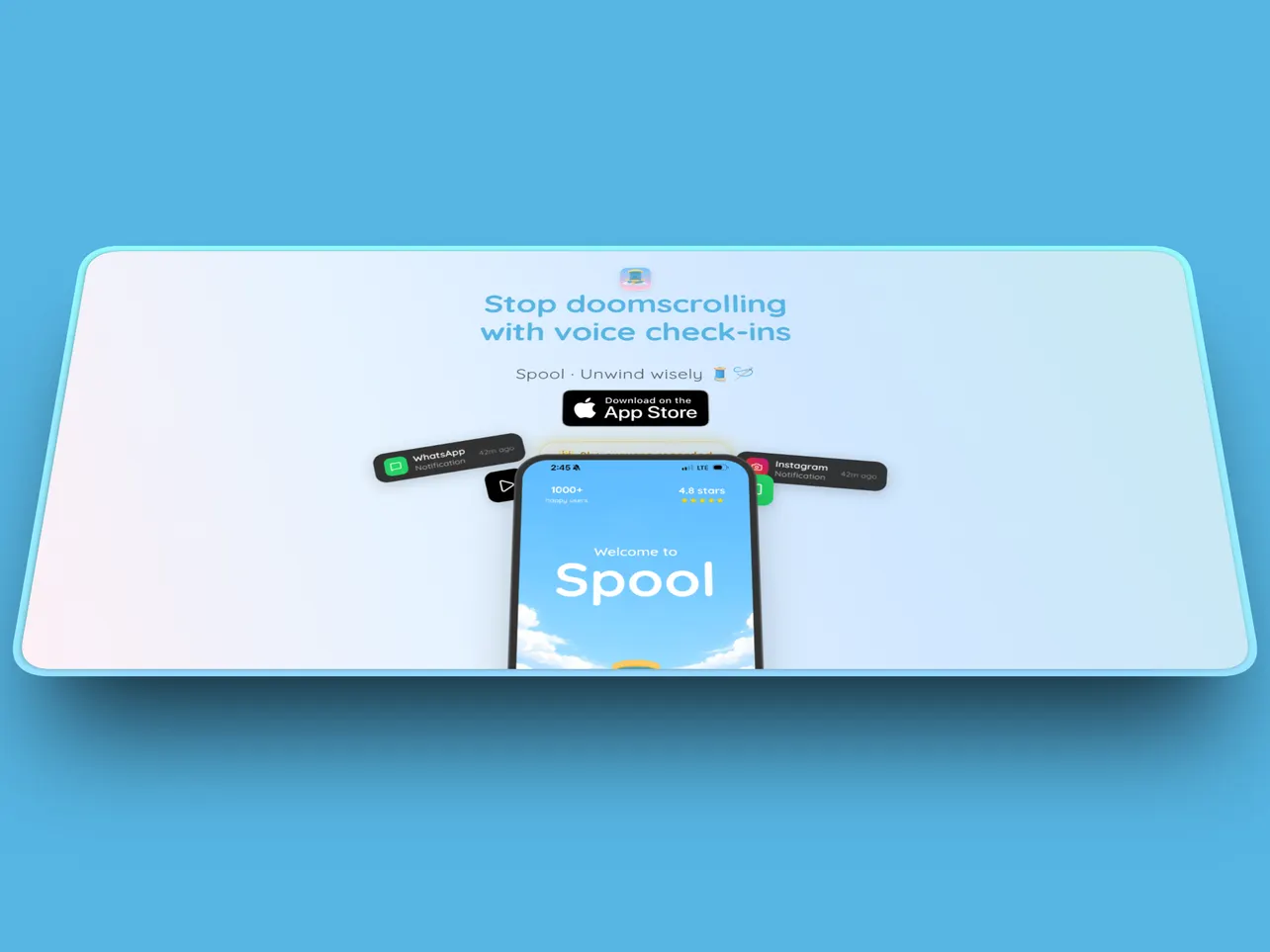
A study of 8,667 voice recordings from Spool caught the exact moment people reached for a blocked app. The reasons they gave, shared with us by co-founders Prafull Sharma and Jainam Manot, are smaller and stranger than you would guess.
There is a five-second window most digital wellbeing research never sees.
It sits between the urge to open an app and the moment the app actually opens. By the time anyone usually asks you about your phone habits, that window has closed and you are reconstructing it from memory, which means you are guessing.
A small iPhone app called Spool decided to record the window itself. When a user tries to open an app they have blocked, Spool asks them to say out loud, in five seconds, why. The recording gets transcribed. Each one is a tiny confession spoken to a phone that is, for a moment, refusing to cooperate.
We were given exclusive first access to the cleaned dataset: 8,667 of those recordings from 193 people, captured between August 2025 and May 2026. It is the first time we have seen language data from the exact second of the reach, and the reasons people give are not the reasons they think they have.
"I need to" wins, but only if you count people
Here is the finding that reframes everything else.
Ranked by different people
how many users independently start this way
Ranked by raw count
how many times the phrase appears in total
8,667 voice-recorded excuses, 193 users. Same data, two honest rankings.
If you rank the opening phrases by how many times they appear, "I want to" runs away with it: 2,011 uses against 822 for "I need to." Volume says want is the dominant verb.
But raw counts lie here, and they lie in a specific way. The dataset is lopsided. The median person contributed 6 excuses, while the ten heaviest users produced roughly half of everything in the file. Count by occurrence and you are mostly measuring the handful of people who open the app twenty times a day.
So Prafull Sharma, Spool's co-founder, ranked the phrases a second way: by how many different people independently start an excuse with them. On that measure the order flips. 107 separate users reach for "I need to." Only 95 reach for "I want to." More people frame the urge as a need than as a want, even though want is louder in the totals.
That distinction matters because it changes what the data is about. Occurrence counts tell you what a few heavy users say. Unique-user counts tell you what people reach for in common, across strangers who have no connection to each other. And what they reach for in common is the language of obligation. Not "I would like to check Instagram." "I need to."
Your phone craving does not present itself as a craving. It presents itself as an errand.
The reason you give yourself is not the reason you signed up to fix
When people install an app to cut down their phone use, they describe the problem in big terms. Spool logged what users said their goal was at onboarding:
| What people said at signup | Users |
|---|---|
| Too much doomscrolling | 24 |
| Attention span | 21 |
| Bad mood | 11 |
| Disconnected from people | 7 |
These are identity statements. They are about the kind of person you have become and want to stop being. Doomscrolling is a character flaw. A shrinking attention span is a fear about your own mind.
Now look at what the same people say in the moment, when the app is blocked and they have five seconds to explain themselves. The reasons get small:
| In-the-moment reason | Share of excuses |
|---|---|
| Social | 28.5% |
| Entertainment | 15.7% |
| Break/Reward | 8.1% |
| Boredom | 7.5% |
| Procrastination | 5.5% |
| Quick Check | 5.1% |
| FOMO | 3.3% |
Nobody opens their phone to doomscroll. They open it to check one message, watch one video, see what a friend posted, reply to a brand. Sharma puts it cleanly: the reason people give for the habit is identity, and the reason they give at the moment of the reach is a small social want. The first is who you are afraid you are. The second is just wanting to see if anyone texted back.
This is the gap, and it is the most useful thing in the whole dataset.
You set a goal against the big version of the problem. You then meet the problem in its small version, dozens of times a day, where it never once looks like the thing you swore off. "Stop doomscrolling" has no defense against "I just want to see my post." They are not even arguing about the same thing.
What the urges actually sound like
The categories are tidy. The recordings are not, and that is the point. These are real, verbatim excuses, each from a different user, cleaned of names and anything identifying. Read a few and the dataset stops being a chart.
Some are purely social, aimed at a specific person:
"i want to show my mom a video" "I need to reply to a brand" "i want to respond to my friends message"
Some are the small bargains people strike with themselves, the break you have decided you have earned:
"I need my little few minutes of scrolling" "I just need a little break from work" "i want to unwind after working out please"
Note the "please." It shows up more than you would expect, people negotiating with an app as if it might say yes.
Some name the boredom directly, with a candor nobody uses out loud:
"i just feel like scrolling for some reason" "I want to scroll memes while I poop" "i want to scroll because i can't sleep"
And some are pure procrastination, where the user states the exact thing they are avoiding in the same breath as the thing they want instead:
"i want to scroll before my class starts" "I need to study for my science midterm" "I want to scroll insta in class rn"
That last cluster is almost a genre on its own. People know. The recording is not denial. It is a person watching themselves reach for the phone, narrating it in real time, and reaching anyway.
The urge has a schedule
The recordings are not spread evenly across the day.
When the urge hits
recorded excuses by hour of day
8,667 voice-recorded excuses, 193 users. Hours shown in users' local time.
The volume climbs steeply from about 5am, holds high through the working day, and peaks around midday and again near 7pm. The pattern is less "bored at night" than you might assume.
The heaviest reaching happens in the middle of things, during work and study, exactly when people have something else they are supposed to be doing. The procrastination quotes and the time chart are telling the same story from two directions.
What this means if you are trying to use your phone less
The practical takeaway falls straight out of the gap.
Most screen-time advice is aimed at the identity-level problem, because that is how people describe it when they ask for help. Cut your doomscrolling. Fix your attention span. But you do not encounter the habit at the identity level. You encounter it five seconds at a time, as a small, reasonable-sounding want that does not resemble the thing you are trying to quit.
A resolution made against "doomscrolling" simply is not present in the moment when the actual decision happens. What is present is "I just want to check one thing," and that sentence wins because nothing is there to answer it.
Which is what an app like Spool is doing. It does not lecture you about your attention span. It just inserts a person, you, into the five-second gap and makes you say the small reason out loud. Said aloud, "I need to check my notification" stops sounding like a need. That is the whole mechanism, and the data is a record of it working and failing in real time, thousands of times over.
The reasons people give before they pick up their phone are smaller than the reasons they think they have. Closing the distance between the two might be the entire game.
What is Spool?
Spool is an iPhone app that asks users to say out loud, in five seconds, why they want to open an app they have blocked. The voice recording is transcribed, and that recording is what this dataset is built from. You can find it at thespoolapp.com.
How was the data collected?
Every entry is a single voice recording made at the moment a user tried to open a blocked app, between August 2025 and May 2026. After cleaning, the set contains 8,667 recordings from 193 users. Phrase rankings are reported primarily by unique users rather than raw counts, because a small number of heavy users would otherwise dominate the totals.
Is the data representative of everyone?
No, and it is worth being clear about that. Everyone in the sample chose to install an app to reduce their phone use, so it over-represents people already trying to change the habit. There is no control group, so the data describes what people say, not what they would have done otherwise. A small share of recordings carry voice-to-text artifacts.
What about the app names like Instagram and TikTok?
Only about 14% of excuses carried an app tag, since tagging was added partway through the collection window. On that smaller subset Instagram and TikTok dominate, but it is a slice of the data rather than the whole, and we have treated it as a footnote rather than a headline.
Data shared exclusively with We Are Founders by Prafull Sharma and Jainam Manot, co-founders of Spool. Figures are observational and drawn from an opt-in sample with no control group. Phrase and category counts are reproducible from the cleaned dataset.
Download the App on the App Store.