
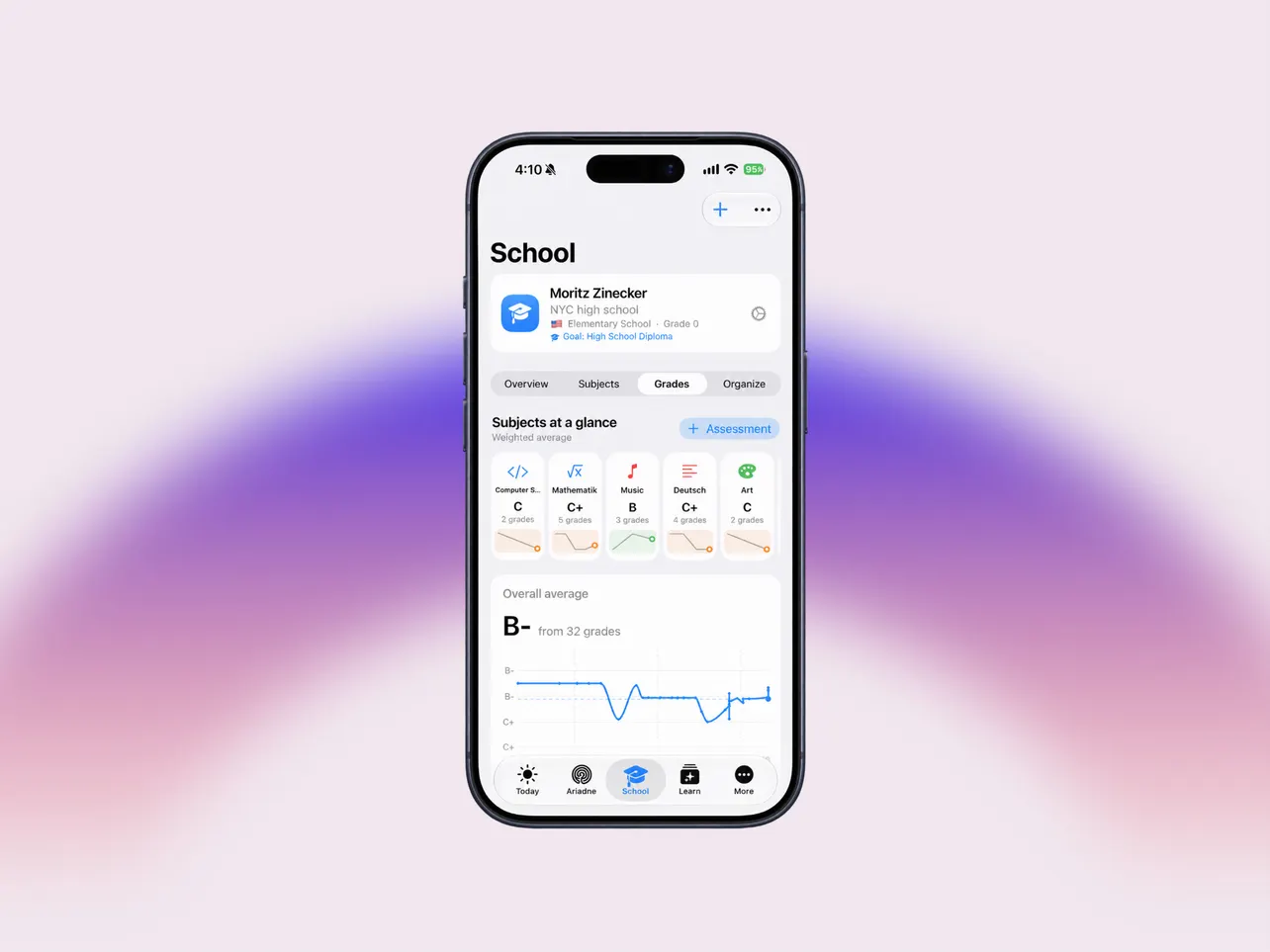
Moritz Zinecker of Audecius UG is building Clarity School, an app in the App Store that connects learning, tasks and planning so a deadline turns into a manageable next step for today. The idea took shape during an exchange year in the US, when an old project called Day Planner was revisited in light of two very different school systems.
We spoke to Moritz over email about why an AI that finishes the homework isn't the same as one that helps you learn, what it took to set up a company in Germany, and how to keep a clear line between what's published and what's still a plan.
Clarity grew out of your experience of education in Germany and the US. When did the gap between knowing a deadline and deciding what to work on today start to look like something worth building a product around?
The idea took shape during an exchange year in the US, when an old project called Day Planner was revisited in light of experiences of two different school systems. Information was scattered across different tools, and knowing what was due did not necessarily make the next practical step clear.
Before developing the project further, we mapped out on paper who it should serve and what those people needed. That became the direction for Clarity: connecting learning, tasks and planning so that a deadline can lead to a manageable next step today.
How did you turn that problem into the first version of Clarity School, and what did you leave out on purpose?
We began with personal organization in Clarity School and deliberately left the family features for the next generation, not because we saw less potential in them, but because they deserved more development time.
Our vision reaches beyond an individual student's timetable: as AI changes the digital world children grow up in, the planned Family Hub should help parents understand that world, agree shared rules and allow more freedom as their children become more independent.
Our quality test is personal: would we recommend this to our own families? A feature earns its place through a clear purpose and thoughtful execution, not simply because it is technically possible.
You're building a company alongside a product. Which unfamiliar discipline has taken the most learning, and how have you gone about picking it up?
The steepest learning curve has been the formal side of building a company in Germany. There was already some business experience from the US exchange year, but the German processes were still unfamiliar.
We approached them through self-study, advice from a tax adviser and support from family. For months, learning how to build the company and developing the product happened in parallel; neither could simply wait for the other to be finished.
When several responsibilities compete for the same week, how do you decide what matters next?
Product development generally comes first, with a simple test: would we recommend what we are releasing to our own siblings and family? That keeps our attention on quality and practical value, particularly when deciding how to use AI: finishing a homework task is not the same as understanding it.
We want Clarity to help students, parents and teachers find the support that enables someone to move forward for themselves. Feedback from existing use and the Clarity 2 beta has encouraged that direction; users telling us the approach helps them in daily life is a reason to keep developing the connection between learning and organization, not a claim of proven learning outcomes.
What did you try or build early on that you later dropped, and what did it teach you?
We initially experimented with different AI learning features, but generating learning material did not automatically mean someone was learning better. Some workflows, including generated math tests, were used to reach solutions as quickly as possible, so we dropped the idea of placing ever more generic AI tools side by side.
Our question became: does this process actually support understanding? That led to the direction we call Personal Intelligence: Clarity should consider not only what someone wants to learn, but also what kind of support helps that person learn. The most important lesson was that the fastest answer and the best path to learning are often two different things.
Clarity School is published and Clarity 2 is still in development. What is available today, what remains a plan, and how do you keep that distinction clear for yourself and your users?
Clarity School version 1.1 is publicly available in the App Store. Clarity 2.0, Build 7, has been resubmitted and is waiting for App Store review; submission is not approval or public release.
The next-generation work, including Personal Intelligence and the Family Hub, should therefore be understood as our development direction rather than functionality users can already access in the published version. We keep those stages separate in how we describe the product and are not promising a launch date before release is confirmed.
What would you tell someone about to start a similar build, and what would you do differently if you were starting again?
Put an early version in the hands of real people and take their feedback seriously. That is something we would keep: early beta tests with friends and people in the intended audience, including teachers, brought perspectives that our own experience alone could not provide.
What we would change is the time allowed for the formal company-formation process. We would give it more lead time from the outset, while continuing product development alongside it.
Find Clarity School
Clarity School is available for iOS and Android.
This Q&A is unpaid editorial content. We Are Founders received no payment for this feature, and the answers are Moritz's own, lightly edited for length and clarity.