
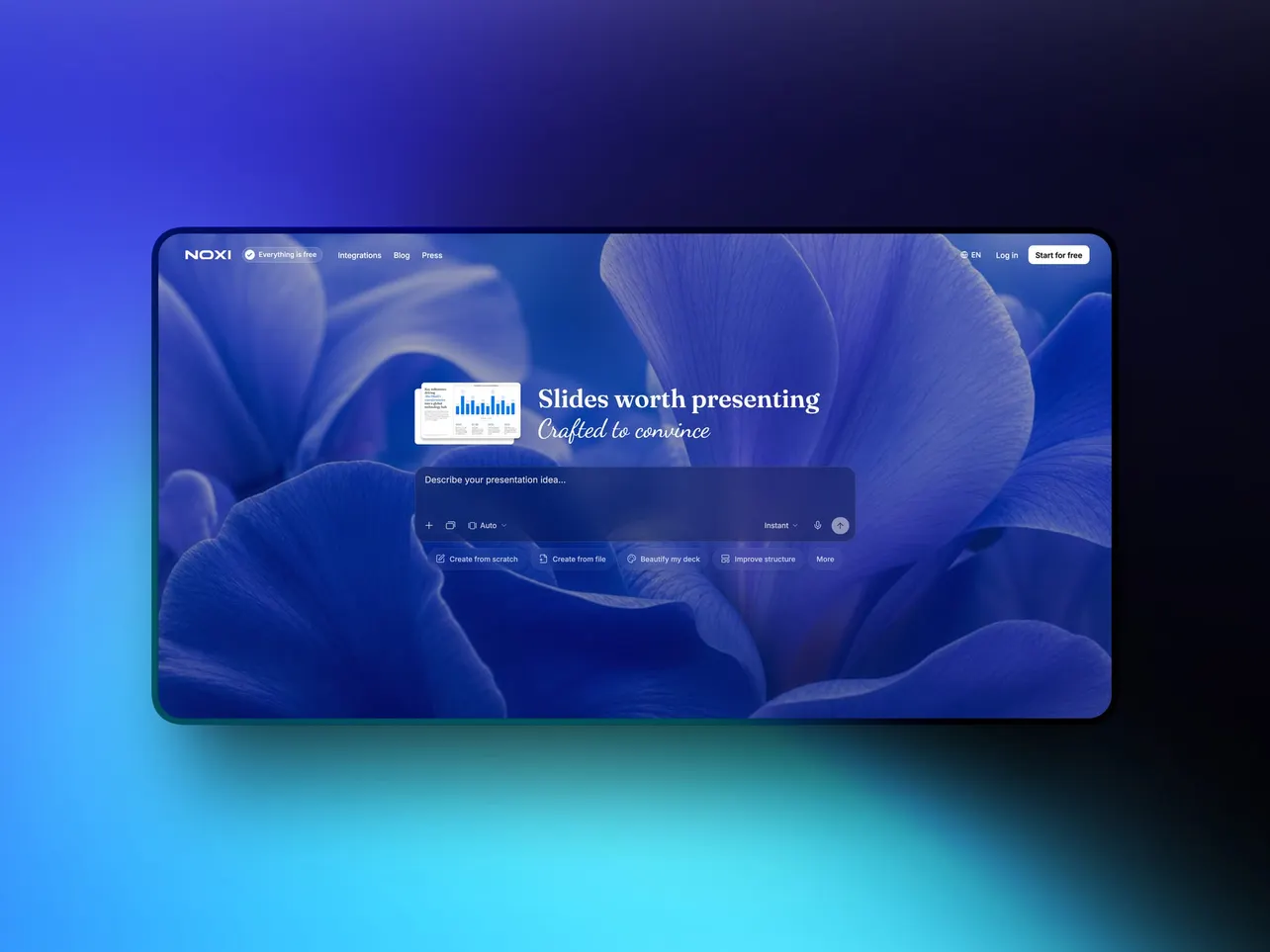
Aidar Akmaev is a product designer who made enough presentations to learn how hard a good one is to get right, so he built the tool he wanted. NOXI, which he runs alone from Abu Dhabi, turns a brief or a report into a finished PowerPoint with sources on the slides.
It's free to use, with no watermark and no card required, and by Aidar's own count it has reached 2,600 sign-ups with no funding and no ads. Close to 4 in 10 new decks are now in Arabic.
We caught up with Aidar over email to ask why he skipped templates, why he wrote his own export engine, and how more than eighty Arabic articles help people find NOXI when a real deck is due.
You're a product designer who built NOXI alone. What was the moment you decided to build it rather than design it for someone else?
I made a lot of presentations, and I learned how hard it is to make a good one, with strong design and properly thought through. An investor deck is often made by a whole team: a designer, a head of strategy, a venture builder. It still takes a long time.
Tools like Gamma were already popular, but they weren't built for that kind of professional work. They were fine for a teacher or a student, but for a deck going to investors or leadership you couldn't even use them as a draft. I could see AI getting much stronger, nobody was really building for that kind of work, and it felt both interesting and important. So I decided to build it.
NOXI turns a brief or a report into a finished PowerPoint with sources on the slides. Why did you make citations a core part of the output?
Sources work as proof. They show that the slides are based on real information, not something the AI made up. NOXI decides by itself where a source is needed and where it isn't, so you don't get citations on every line, only on the figures and claims that need them. Charts are built from real data too.
Close to 4 in 10 new decks are in Arabic. What did it take to support Arabic properly, and what surprised you?
I live in the UAE, so building something that really works for the Arab region mattered to me from the start. I could also see that most tools still don't pay attention to Arabic, because it's genuinely hard. Everything is different: the whole layout runs right to left, Arabic sits next to English names and numbers, and PowerPoint export is still a problem for a lot of products.
Many exports simply break with Arabic. That's why I wrote our own export engine. The response surprised me. In August, under 2% of new decks were in Arabic, and now it's close to 4 in 10.
You've reached 2,600 sign-ups with no funding and no ads. Where did those first users come from?
Word of mouth in Abu Dhabi first: managers and teachers who passed it on. Then search. I've written more than eighty articles in Arabic about making presentations that work, and people find them when they have a real deck due. It also helps that NOXI is free, with no watermark and no card, so trying it costs nothing.
What did you build early on that you later dropped, and what did it teach you?
Two things. The first, almost from the start, was templates. Most tools still work that way: there's a ready-made template and your text is poured into it. I moved away from that because I could see how fast AI was improving, and I wanted to give people freedom.
You can say or write whatever you need, and NOXI tries to build exactly that and take everything into account, without a fixed set of layouts holding you back. The second was export. Early on, NOXI made its files by rendering the slides in a browser and converting them. It worked in demos but failed too often in real use, especially with Arabic, so I built our own engine.
How do you decide what to work on next when you're the only person on the product?
I collect feedback all the time. There's a feedback base I go through, users can message me directly in a chat, and people can rate the decks they get. Just as important, I spend a lot of time every day trying to understand where the AI market is going and how things will look in two years.
What made sense a year ago often doesn't anymore. I've built things myself that later turned out not to be useful and had to be removed or rebuilt. Trying to see ahead is what lets you make a real leap instead of catching up.
Which founders inspire you, and what have you taken from them?
People who build something big. Honestly, MrBeast amazes me with how brilliantly he does what he does, and Elon Musk amazes me too, as he does most people. I also work alongside a lot of very talented people at a venture company in Abu Dhabi who build ambitious projects, and that inspires me every day.
Try NOXI
You can try NOXI for free at noxi.ai, or in Arabic at noxi.ai/ar.
This Q&A is unpaid editorial content. We Are Founders received no payment for this feature, and the answers are Aidar's own, lightly edited for length and clarity.