

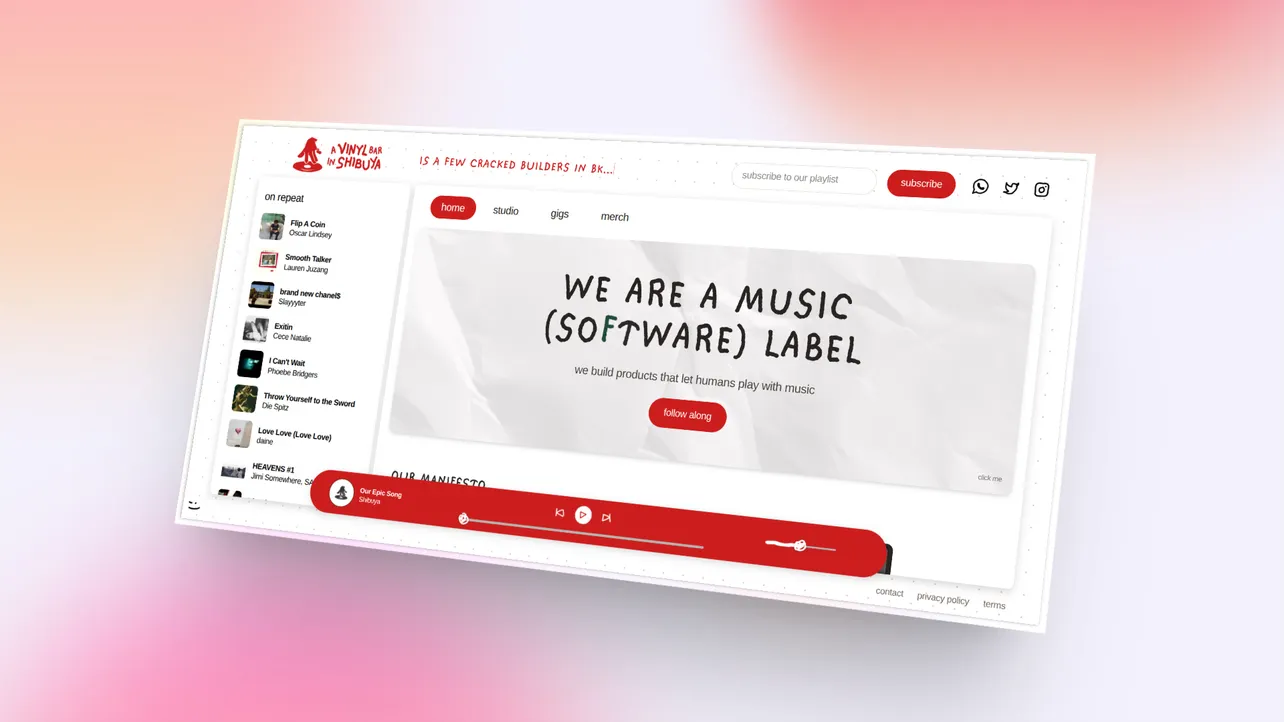
There’s something immediately appealing about a startup called A Vinyl Bar in Shibuya. Before you know what it does, the name gives you a feeling. Somewhere you might wander into, hear something unexpected and stay longer than planned.
That sense of curiosity runs through the company itself. Founded by former Spotify head of innovation Máuhan M. Zonoozy, A Vinyl Bar in Shibuya is building small music apps that invite people to experiment with sound.
According to TechCrunch’s reporting by Ivan Mehta, the startup has raised $5.5 million in pre-seed funding. Backers include Mantis VC, SV Angel and BoxGroup, with former Spotify executive Dawn Ostroff also investing and joining as an adviser.
The idea behind it’s easy to understand: listening is only one way to enjoy music.
The Opportunity He Saw at Spotify
Zonoozy left Spotify in 2024 with an interest in building another company of his own. He’d previously founded Bubbl, a video clipping and remixing startup acquired by Cricket Media.
As he explained to TechCrunch, streaming had made music accessible, but the experience still largely revolved around consumption. Meanwhile, younger audiences were already using games, filters and creative tools to put their own stamp on culture.
Music offered room for more of that participation.
It’s a useful observation for founders. Spending years inside an industry can make its conventions feel inevitable. Here, the question was whether listeners might enjoy having more to do with the songs in front of them.
Small Apps With Room to Explore
The company describes itself as a music software label and presents its releases as singles. Each gives people a particular way to interact with sound.
Stacks lets users alter a mix by switching musical parts on and off. Drops turns falling objects and the placement of planks into a way of shaping a beat. Usersound lets people create a personal chime, while Shibby Sampler makes YouTube clips playable through a sound pad.
You can explore the releases on the company’s website.
What makes the approach interesting is the size of the invitation. Moving an object or switching a sound on feels approachable. Someone can follow their curiosity and hear the result of a decision without first committing to learning music production software.
For a founder, there’s a product lesson in that. A small interaction can communicate the appeal of an idea remarkably quickly. It also gives a team something specific to watch: do people keep experimenting once they understand what happens?
Keeping People Involved as AI Enters the Mix
The company’s more ambitious app, bop, lets users arrange instruments and effects on a grid, change the tempo and export their mixes to social platforms. TechCrunch reports that a multiplayer version is also in development.
AI has a place here too. The company recently added a feature that generates a sound from a prompt, a detail worth preserving when discussing its approach.
Zonoozy’s argument is that human taste and participation become more valuable as generated music becomes more abundant. His products leave room for people to make decisions, try combinations and enjoy the process themselves.
That’s the part of this story that sticks with me. There’s pleasure in making a small change and hearing something you like. An app can make that moment accessible to someone who’d never describe themselves as a musician.
Will People Keep Coming Back?
The commercial question is how those moments become a lasting habit. Funding gives the team room to experiment, but it doesn’t tell us whether someone who enjoys an app today will return next week.
Releasing a collection of small products creates its own challenge too. They’ll need to work out which experiences deserve more attention and how they fit into a business people will support.
Still, there’s plenty to like about the starting point. A Vinyl Bar in Shibuya has spotted an ordinary human impulse, wanting to mess around with something you love, and built products around it.
I’d happily see more founders start there.
Based on Ivan Mehta’s reporting for TechCrunch, with product descriptions checked against A Vinyl Bar in Shibuya’s website. Commentary is We Are Founders’ own.