

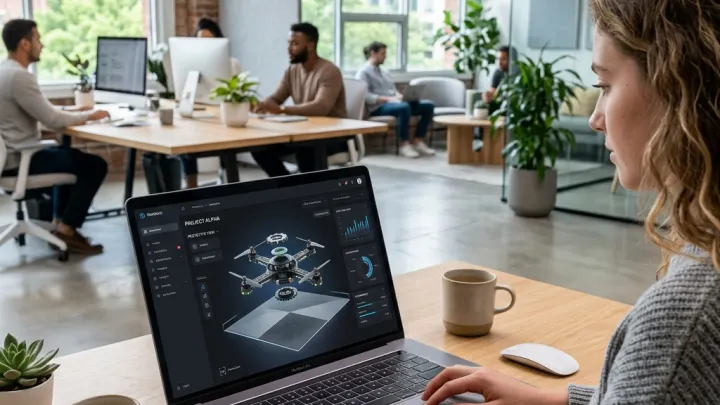
Early-stage hardware and product design startups face an uphill battle when trying to bring a physical concept to market. For years, the financial burden of industrial design software and the steep learning curve of technical modeling acted as severe barriers to entry for independent founders.
Developing a single production-ready prototype could easily consume weeks of expensive agency fees and constant revisions. Today, this traditional friction is being eliminated by advanced machine learning frameworks.
Cutting-edge platforms like Neural4D are restructuring how founders iterate on physical designs by allowing them to convert flat sketches and standard reference images into fully dimensioned, high-fidelity 3D models in a matter of minutes.
This democratization of spatial design is a direct result of intense academic research meeting commercial software distribution. Neural4D emerged from rigorous joint research conducted by teams at Nanjing University, DreamTech, Oxford University, and Fudan University.
By utilizing proprietary Spatial Sparse Attention (SSA) technology and the Direct3D-S2 framework, the platform delivers exceptionally fast and accurate SaaS 3D modeling tools accessible directly through standard web browsers.
The ability to instantly generate, modify, and export millimeter-accurate digital prototypes empowers small founder teams to reduce their initial capital burn rate while dramatically accelerating their time to market.
The Financial Bottleneck of Hardware Development
Hardware is notoriously difficult for bootstrapped founders.
Unlike software development, where iterations cost very little, physical product design demands absolute precision before committing to costly manufacturing runs. In a traditional hardware startup workflow, visualization and prototyping are completely tied to capital expenditure.
Historically, a founder with a concept sketch would need to hire a specialized 3D artist or an industrial engineer to build a CAD (Computer-Aided Design) model. This process requires constant back-and-forth communication.
If a structural issue is identified during the first 3D print, the founder must pay the engineer to modify the geometry, re-export the files, and prepare them for another test print. When an early-stage company is operating on pre-seed funding, these repetitive modeling costs become a massive financial drain.
By integrating automated generative systems into their daily operations, startup founders completely bypass this bottleneck.
1. Rapid Ideation Testing: A founder can sketch five different variations of a consumer electronics casing, feed those sketches into an AI generator, and immediately evaluate the 3D geometry of all five options simultaneously.
2. Eliminating Agency Dependency: Small teams no longer need to keep expensive 3D generalists on retainer just to visualize basic concepts or create marketing mockups for pitch decks.
3. Accelerated Iteration Cycles: When the time between having an idea and holding a physical prototype shrinks from weeks to hours, product-market fit can be achieved significantly faster.
Optimizing the E-Commerce Launch Strategy
Beyond hardware prototyping, these advanced SaaS solutions are fundamentally shifting how new Direct-to-Consumer brands launch their storefronts.
Consumer expectations are exceptionally high, and static photography is rarely enough to build trust for a completely unknown brand. Modern shoppers expect interactive experiences where they can rotate, zoom, and inspect products before purchasing.
For a new e-commerce startup, rendering photorealistic 3D environments for every product SKU used to be financially impossible. It required renting physical studio space, hiring lighting technicians, and coordinating complex photo shoots.
Now, a founder can use a smartphone to capture a short video of their initial physical sample. The generative AI processes the spatial data to create a perfect digital replica, which can then be placed into any virtual environment for endless marketing permutations.
· Pre-Selling Without Inventory: Startups can generate photorealistic digital twins of products that have not yet been manufactured, allowing them to test market demand and secure pre-orders before committing to expensive factory minimum order quantities.
· Augmented Reality Integration: Generated 3D meshes can be optimized instantly for mobile AR viewers. This allows potential customers to project the digital item directly into their living rooms, increasing buyer confidence and drastically reducing return rates.
"The true advantage of integrating generative 3D tools into a startup is not just speed. It is the ability to test complex physical ideas with zero marginal cost, allowing founders to fail fast and pivot without bankrupting the company."
Fostering a Global Maker Ecosystem
While proprietary SaaS platforms are providing founders with immense commercial value, the underlying technology is simultaneously empowering open-source hardware communities. The ability to easily generate and modify 3D objects has created a massive influx of user-generated designs.
Independent creators, makers, and early-stage engineers are actively sharing their optimized digital components. For founders building hardware that requires generic parts, such as specific mounting brackets or standardized mechanical enclosures, they can turn to community resources rather than modeling everything from scratch.
A highly useful example of this is the DIY3D printer-agnostic library, where creators upload thousands of structurally verified models that are ready for immediate physical production. By leveraging these shared repositories, hardware startups can piece together complex mechanical prototypes using community-tested parts, ensuring their limited resources are focused solely on their unique core innovation.
Implementation Guidelines for Early-Stage Teams
For founders looking to adopt these generative tools, several operational factors must be considered to maximize the return on investment.
Format Compatibility: The SaaS platform must export models in standard industry formats such as OBJ, FBX, or STL. This ensures that the generated assets can be directly imported into established engineering software or sent directly to local rapid prototyping facilities without requiring manual file conversions.
Topology Requirements: A generated mesh might look visually perfect but possess underlying geometric flaws that prevent physical manufacturing. Founders must choose platforms that offer intelligent mesh decimation and manifold geometry optimization, ensuring the files are watertight and structurally sound.
Data Ownership: When uploading proprietary product concepts to a cloud-based generative platform, founders must strictly review the terms of service. Ensuring that the startup retains full intellectual property rights over the generated 3D assets is non-negotiable for future patent filings or investor due diligence.
The integration of spatial artificial intelligence into commercial SaaS platforms is completely leveling the playing field for hardware and product startups. By removing the financial and technical friction associated with traditional 3D modeling, these tools allow founders to allocate their capital toward actual engineering and market expansion.
The companies that learn to rapidly iterate using these advanced generative systems will undoubtedly hold a significant structural advantage in the competitive landscape of early-stage venture building.