You've got traction.
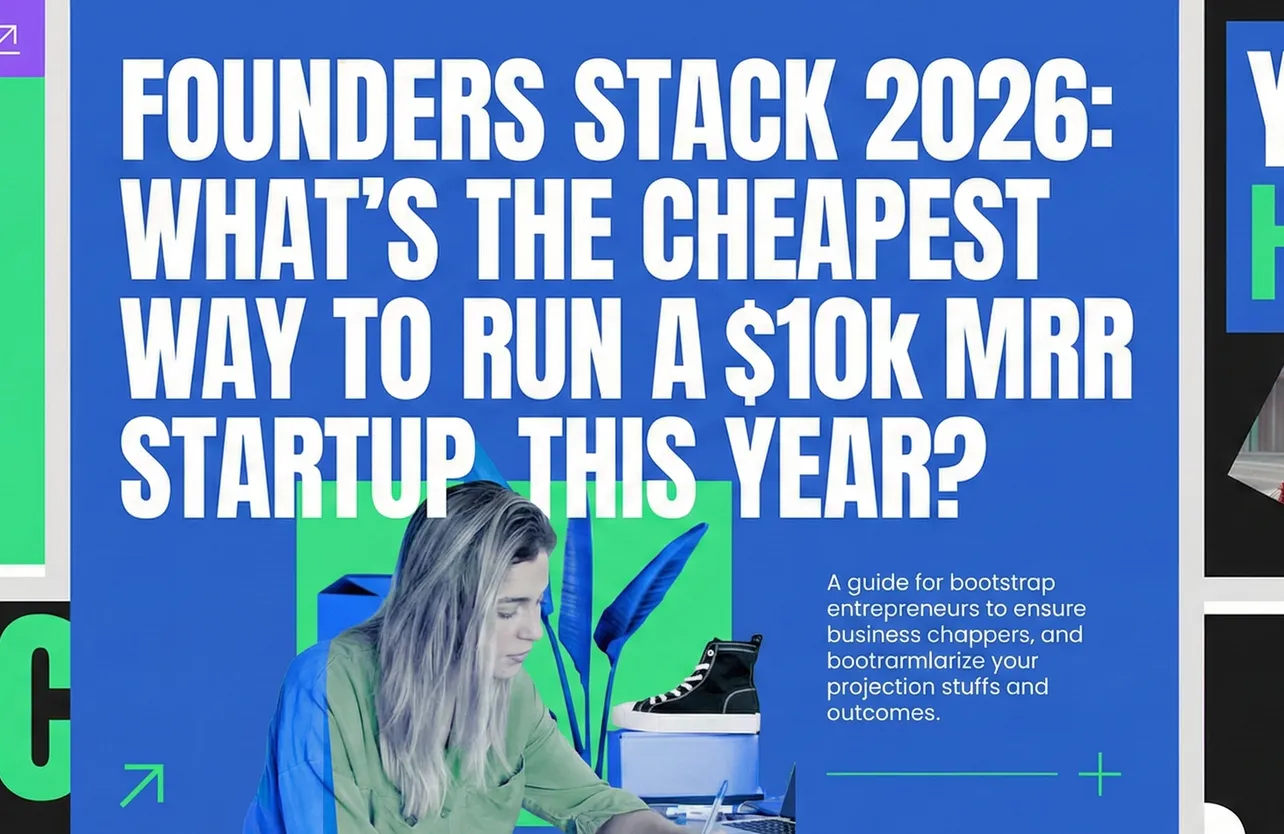
Your startup is pulling in $10k monthly recurring revenue, which means you're past the idea stage but nowhere near Series A territory. You're in that sweet spot where every dollar matters, where choosing between Notion and ClickUp could mean the difference between ramen and real groceries this month.
But there's good news. Running a lean startup in 2026 is cheaper than it's ever been. Oh, and there's also bad news too. There are approximately eight million SaaS tools competing for your credit card, most of which you absolutely don't need.
After analyzing dozens of successful bootstrapped startups and testing the latest tools, I've put together the actual cheapest tech stack you can run in 2026 while still looking professional and staying sane.
No bullshit, no affiliate links disguised as advice. Here are the real numbers.
The Total Damage: $147/month (or less)
Here's what it actually costs to run a $10k MRR startup without cutting corners that matter:
- Core infrastructure: $50/month
- Essential tools: $97/month
- Nice-to-haves if you're feeling fancy: $50/month
Compare that to the "recommended" startup stack from most tech blogs, which will run you $500+ per month. Yeah, no thanks.
Foundation Layer: The Stuff You Actually Need
Web Hosting: $2-4/month
Stop paying $30/month for hosting. Seriously.
Hostinger remains the champion of cheap hosting in 2026, with plans starting at $1.99/month for a 48-month commitment. If you're not ready to commit four years to a hosting provider (fair), their annual plan runs about $2.99/month and still gives you 25 websites, 25GB of storage, and a free domain for year one.
DreamHost offers something unique: true month-to-month hosting for $10.99/month with no long-term commitment, making it perfect if you're still testing your business model. Once you're confident, lock in their annual rate and pocket the difference.
The move: Start with Hostinger's annual plan at $2.99/month. Migrate to their 4-year plan once you hit $5k MRR consistently.
Email: $0
Wave goodbye to Google Workspace's $6/user/month tax.
In 2026, there are solid free options that won't make you look like you're running a geocities site. Zoho Mail gives you a custom domain email for free (up to 5 users), and it actually works.
The interface isn't going to win design awards, but your customers won't know the difference when you email them from hello@yourstartup.com.
If you absolutely need the Google ecosystem, pay for one Google Workspace account and use aliases for different departments. Sales@, support@, and hello@ can all route to the same inbox.
The move: Zoho Mail free tier until you have a team of 6+, then reassess.
Domain: $12/year
Your domain costs $12 annually. That's it. Don't overthink this.
Most hosting providers throw in a free domain for the first year anyway, so your actual first-year domain cost is $0. Just remember to turn off auto-renewal on those domain privacy protection upsells. You don't need it.
The move: Get the free domain with your hosting, set a calendar reminder 11 months out to shop for renewal deals.
Productivity & Operations: Where Most Founders Waste Money
Project Management: $0-10/month
The Notion vs. ClickUp vs. Asana debate is exhausting, and honestly? Most $10k MRR startups can get by with the free tiers.
Notion's free plan is genuinely generous in 2026. You get unlimited pages and blocks, which is plenty for a small team. The AI features that everyone raves about? You don't get those on free, but you also don't need them when you're this early.
Trello remains the simplest option if your brain works in boards. Their free tier handles unlimited cards and up to 10 boards, which will cover you until you're way past $10k MRR.
If you need something beefier, ClickUp's free forever plan is absurdly feature-rich. The catch? It has a learning curve steeper than learning vim. Budget time for setup, not just money.
The move: Start with Trello if you want simple. Graduate to Notion when you need documents and databases in one place. Only pay for ClickUp ($7/month) if you have complex workflows and team dependencies.
Communication: $0
Slack's free tier got nerfed in 2024, limiting message history to 90 days. But guess what? For a tiny team, that's still fine. You're not going to be searching for a message from 6 months ago every day, and if you are, you have organizational problems that paid software won't fix.
Discord is the dark horse here. It's free forever, has unlimited message history, and honestly works great for small startup teams. The only downside is explaining to potential investors why your team coordination happens on a gaming platform. (Worth it for the cost savings, in my opinion.)
The move: Discord for completely free everything. Switch to Slack if you're hiring fast and need integrations with enterprise tools.
File Storage: $0-2/month
Google Drive gives you 15GB free. For early-stage file storage, that's plenty. Once you hit the limit, you can:
- Pay $2/month for 100GB through Google One
- Delete old files like a responsible human
- Set up a second Google account and use it as cold storage (hacky but effective)
The move: Free Google Drive, upgrade to the $2/month plan only when you actually hit limits.
Customer-Facing Tools: Don't Cheap Out (Too Much)
Customer Support: $0-15/month
Your customer support tool is one place where "free" might actually hurt you.
tawk.to is completely free forever, including unlimited agents and chat conversations. The catch? It looks... fine. Not amazing, but fine. If you're B2C and moving fast, this works.
For B2B, consider BoldDesk's startup plan. You get professional ticketing, a knowledge base, and email integration starting at $12/user/month. When you're charging customers real money, looking professional in support interactions matters.
The move: tawk.to for B2C or early testing. BoldDesk once you have paying B2B customers.
Email Marketing: $0-20/month
Mailchimp's free tier (up to 500 contacts) has been the default forever, but Brevo (formerly Sendinblue) is lowkey better in 2026. You get 300 emails per day forever free, which is enough for a growing startup's transactional emails and occasional newsletters.
When you outgrow free, Brevo's paid plans start at $9/month, significantly cheaper than Mailchimp's $13/month entry point.
The move: Brevo free tier, upgrade at $9/month when you need more sends.
Website Analytics: $0
Google Analytics 4 is free and more powerful than you need. Yes, the interface is confusing. Yes, you'll need to watch a YouTube tutorial. But it's free and it works.
If GA4 makes your brain hurt, Plausible has a beautiful simple interface starting at $9/month. Only pay for this if you genuinely can't figure out GA4 after trying.
The move: Google Analytics 4, suffer through the learning curve.
Development & Technical Tools: Free is Actually Good
Code Repository: $0
GitHub gives you unlimited private repositories for free. GitLab does the same. There's no reason to pay for code hosting in 2026 unless you have very specific enterprise needs, which you don't.
The move: GitHub free tier.
CI/CD: $0
GitHub Actions gives you 2,000 free minutes per month for private repos. That's plenty for a small team's deployment needs. CircleCI and GitLab CI also have generous free tiers.
The move: GitHub Actions until you need more than 2,000 minutes/month (you won't).
Monitoring: $0-14/month
UptimeRobot monitors up to 50 services for free with 5-minute checks. For most startups, knowing your site is down within 5 minutes is good enough.
Better Stack (formerly Better Uptime) has a free tier that's genuinely good if you want more detailed monitoring without paying Datadog's ransom.
The move: UptimeRobot free tier.
Database: $0-5/month
If you're on Vercel or Netlify, their free tiers include database options. Supabase gives you 2 free projects with 500MB database, which is enough for early traction.
For production loads, Railway and Render both have cheap entry points starting around $5/month that'll handle way more than $10k MRR traffic.
The move: Start free on Supabase or PlanetScale, scale to Railway when needed.
Design & Marketing: Scrappy But Not Sketchy
Design Tools: $0-20/month
Canva's free tier is honestly great. You get thousands of templates, basic editing, and enough features to make social posts that don't look like garbage. The Pro plan ($13/month) unlocks brand kits and better templates, which matters once you're trying to build consistent brand recognition.
Figma is free for up to 3 projects, which covers most early-stage startup design needs.
The move: Canva free until you need brand consistency, then upgrade to Pro at $13/month.
Social Media Management: $0-6/month
Buffer's free tier lets you manage 3 social channels with 10 scheduled posts each. For a bootstrapped startup, that's the entire strategy: LinkedIn, Twitter, and maybe Instagram.
When you need more posting power, Buffer's Essentials plan is $6/month for one user, which is absurdly cheap compared to Hootsuite or Sprout Social.
The move: Buffer free tier, upgrade to $6/month when you're posting consistently.
Payments & Finance: Where You Pay For Trust
Payment Processing: Transaction Fees Only
Stripe and PayPal take about 2.9% + 30¢ per transaction. There's no getting around this, and you shouldn't try. Customers trust these platforms, which matters more than saving 0.5%.
The move: Stripe for online payments, done.
Accounting: $0-15/month
Wave is completely free accounting software. Free invoicing, free expense tracking, free receipt scanning. It makes money by offering paid services like payments and payroll, which you can ignore.
QuickBooks starts at $15/month if you need more features, but honestly, Wave handles most early-stage startup accounting needs.
The move: Wave free tier until your accountant insists on QuickBooks.
Banking: $0
Novo offers free business checking accounts with no monthly fees, no minimum balance, and unlimited transactions. The only catch is they make money on interchange fees when you use their debit card, which is fine.
Mercury is popular with tech startups and also free, with better tooling for venture-backed companies (which you're not, so the extra features don't matter).
The move: Novo for free business banking.
The "When You Have Budget" Upgrades
Once you're consistently above $15k MRR and have some breathing room, here's where to invest first:
- Password Manager ($3-4/user/month): 1Password or Bitwarden. Stop sharing passwords in Slack.
- CRM ($15/month): HubSpot's starter CRM or Pipedrive. Track your sales pipeline properly.
- Time Tracking ($9/user/month): Toggl Track if you bill hourly or need to understand where time goes.
- Advanced Analytics ($9-20/month): Plausible or Fathom for privacy-focused analytics that actually make sense.
The Tools You Don't Need (Yet)
Here's what you can safely skip until you're at $25k+ MRR:
- Enterprise Slack ($7.25/user/month)
- Fancy scheduling tools like Calendly
- Employee engagement platforms
- Advanced HR software
- Multi-tool productivity suites
- Social listening tools
- Advanced SEO platforms (Ahrefs, SEMrush)
- Video hosting platforms
These are all fine tools, but they're solving problems you don't have yet. Your problem is getting to $25k MRR, not optimizing team engagement surveys.
Putting It All Together: Your $147/Month Stack
Here's what your actual monthly spend looks like:
- Hosting: $3
- Email: $0
- Domain: $1 (amortized)
- Project management: $0
- Communication: $0
- File storage: $0
- Customer support: $12
- Email marketing: $0
- Analytics: $0
- Code repository: $0
- CI/CD: $0
- Monitoring: $0
- Database: $0
- Design: $13
- Social media: $6
- Payment processing: 2.9% of revenue ($290 on $10k)
- Accounting: $0
- Banking: $0
- Variable costs (Stripe): ~$290/month
- Grand total: $325/month all-in
That's 3.25% of your revenue going to tools. The other 96.75%? That's yours to invest in growth, pay yourself, or save for the inevitable slow months.
The Real Secret: Start Free, Upgrade Intentionally
The best founders I know all follow the same pattern: start with free tiers, actually use the tools, and only upgrade when a specific limitation is blocking revenue.
Not when the tool's marketing team sends you a compelling upgrade email. Not when you read a blog post about "must-have startup tools." When an actual customer-facing problem would be solved by paying for an upgrade.
That discipline is what separates startups that make it to $50k MRR from those that burn out at $8k because they're spending $800/month on SaaS tools they barely use.
Your Move
Here's your action plan:
- Audit your current tools. Cancel anything you haven't used in 2 weeks.
- Set up the free tier stack above. It takes one weekend.
- Put saved money directly into customer acquisition or product development.
- Revisit this stack every time you 2x your revenue.
You don't need expensive tools to build a real business. You need customers who pay you money and enough discipline to spend wisely. Everything else is negotiable.
Now go build something people want to pay for. The tools will follow.