

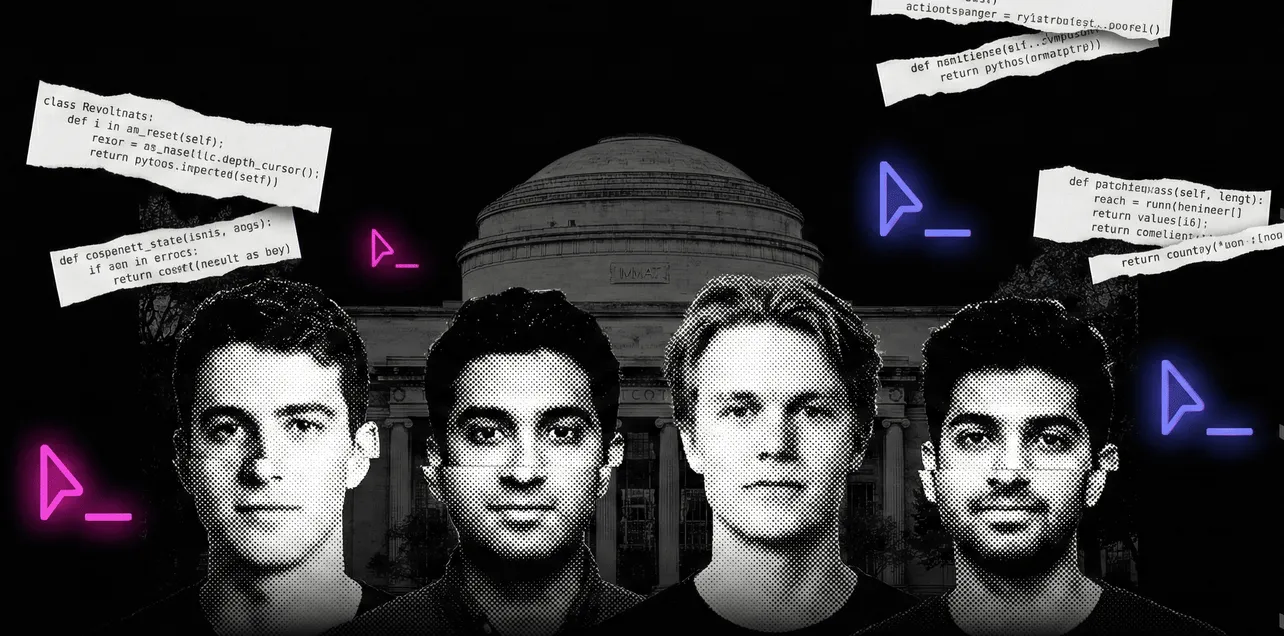
Four MIT graduates turned down Big Tech offers in 2022 to build something different. Today, their AI-powered code editor Cursor has raised over $3.3 billion, reached a $29.3 billion valuation, crossed $1 billion in annualized revenue, and transformed how developers write code — all in under three years.
Meet Michael Truell, Sualeh Asif, Arvid Lunnemark, and Aman Sanger—the Cursor founders who are revolutionizing software development with artificial intelligence.
Who Are the Cursor Founders?
The Cursor founding team consists of four MIT Computer Science graduates from the class of 2022:
- Michael Truell - Co-founder and technical leader
- Sualeh Asif - Co-founder focusing on AI integration
- Arvid Lunnemark - Co-founder specializing in performance optimization
- Aman Sanger - Co-founder driving product development
Together, they founded Anysphere, the company behind Cursor, with a mission to make AI-assisted programming faster and more intuitive than traditional coding methods. Their journey reflects MIT's proven track record of incubating successful AI startups, where student entrepreneurs turn bold ideas into industry-reshaping companies.
The Developer Problem Cursor Solves
If you're using Cursor, you're probably a developer, and there's a good chance you spend half your time wrestling with boilerplate code, debugging the same stupid errors, and waiting for your IDE to catch up with your brain.
It's like trying to have a conversation with someone who responds three seconds after every word you say. The Cursor AI code editor addresses core developer pain points including slow autocomplete, repetitive coding tasks, constant context switching between documentation and code, and time-consuming debugging processes.
Michael Truell discusses Cursor's journey and the future beyond code with Y Combinator.
The founding team saw this friction and asked: "What if we could make coding feel more like thinking?"
They weren't the first to try AI-assisted coding—GitHub Copilot was already making waves. But these four had a different vision. They wanted to build something that didn't just autocomplete your code, but actually understood what you were trying to do.
 Chloe Ferguson
Cursor's Revolutionary AI Technology
What makes Cursor different from GitHub Copilot? While other companies focused on AI code generation, the Cursor founders obsessed over real-time AI collaboration with developers.
Their technical innovations include advanced caching systems with KV Caching that reduces response time by pre-populating cache, cache warming that predicts user needs before input completion, and embedding caching that optimizes code retrieval for large codebases.
They also developed Speculative Editing Technology that predicts developer actions and pre-computes code changes, eliminating loading screens for a seamless editing experience while processing multiple code chunks in parallel for faster generation.
Perhaps most innovative is their Shadow Workspace Feature, where AI agents work in the background without disrupting the main workspace, enabling iterative code improvement with lint tool feedback and future potential for autonomous code testing and validation.
The result? An AI programming tool that feels genuinely fast—not just "pretty good for AI" fast, but actually fast.
Cursor Funding and Valuation Success
Cursor's funding journey has been one of the most remarkable in startup history:
- Series A (August 2024): $60M at a $400M valuation
- Series B (December 2024): $105M at a $2.5B valuation
- Series C (June 2025): $900M at a $9.9B valuation
- Series D (November 2025): $2.3B at a $29.3B valuation
That's a valuation jump from $400M to $29.3B in just 15 months. The Series D was co-led by Accel and Coatue, with participation from Nvidia and Google as strategic investors, notable given both are potential competitors.
Thrive Capital and Andreessen Horowitz have backed multiple rounds, alongside angels including the Stripe founders Patrick and John Collison, former GitHub CEO Nat Friedman, and the founders of Perplexity and Ramp.
Cursor revenue metrics show staggering growth: from $10M ARR at Series A to **$1 billion+ in annualized revenue** by November 2025 — the fastest B2B company to reach $1B ARR in history, crossing the milestone in under 24 months from launch.
Here's the remarkable part: some investors are also potential competitors. OpenAI and GitHub invested despite building competing AI coding tools, validating Cursor's unique approach to AI-powered software development.
The Cursor founders reject the hype that AI will replace programmers.
Instead, they champion a collaborative approach built on three core principles: Speed where AI handles repetitive tasks so developers can focus on creative decisions, Initiative ensuring programmers maintain control over key design choices, and Control that allows seamless switching between high-level concepts and detailed implementation.
What sets Cursor apart from other AI coding assistants isn't just technology—it's philosophy about the future of programming.
"Programmers should stay in the driver's seat," the founders believe, using AI to amplify human creativity rather than replace it.
This pragmatic stance differentiates Cursor in a market full of "AI will do everything" claims, focusing on practical developer productivity improvements.
Cursor vs Competitors: Focus and Execution
What makes Cursor successful compared to other AI coding tools? The founders' laser focus on solving one problem exceptionally well: developer productivity.
While competitors chase flashy demos and broad AI applications, Michael Truell, Sualeh Asif, Arvid Lunnemark, and Aman Sanger have obsessed over sub-second response times, accurate code predictions, seamless VS Code integration, and real-time collaboration between human and AI.
Cursor market position benefits from this focused approach. Instead of trying to revolutionize everything, they're revolutionizing the daily coding experience.
| Feature | Description |
|---|---|
| Remote Sandbox Environments | For complex, long-running development tasks in isolated environments. |
| Enhanced AI Debugging | Expands from basic error detection to more advanced, contextual debugging capabilities. |
| Homomorphic Encryption | Enables secure language model inference while protecting user privacy. |
| Infinite Context Windows | Uses advanced caching to maintain and access large amounts of context seamlessly. |
The founding team continues prioritizing their core principle: make it fast, accurate, and human-controlled.
Cursor in 2026: What's Changed
Since the original Series A, Cursor's growth has been extraordinary even by AI startup standards:
Revenue: From $10M ARR at the time of Series A to $1B+ annualized revenue by November 2025. That's a 100x increase in roughly 14 months. SaaStr called it "the fastest value creation in B2B history."
Team: From a four-person founding team to 300+ employees, while still maintaining the engineering-first culture the founders built from day one.
Product: In October 2025, Cursor launched Cursor 2.0 with its first proprietary AI model, Composer. Described as 4x faster than similarly intelligent models and built specifically for low-latency, multi-step agentic coding. This reduces Cursor's dependence on OpenAI and Anthropic's models.
Market validation: Nvidia CEO Jensen Huang publicly called Cursor his "favourite enterprise AI service." OpenAI attempted to acquire Cursor earlier in 2025.
When that failed, they spent $3B acquiring Windsurf (formerly Codeium) instead. When your competitor tries to buy you, then buys the number two player, that's as clear a validation signal as it gets.
Enterprise adoption: Cursor is now used by the majority of Fortune 500 companies and engineering teams at OpenAI, Stripe, Spotify, Midjourney, and Perplexity.
Key Takeaways: Cursor Founders' Success Story
The Cursor founding story demonstrates how focused execution beats grand vision.
Four MIT Computer Science graduates identified a real developer problem, built practical AI solutions instead of chasing hype, scaled from $0 to $1B ARR in under 24 months.
The fastest in B2B history, raised $3.3B+ from top-tier investors including strategic backers Nvidia and Google, and maintained focus on human-AI collaboration over AI replacement.
Cursor's success shows the future of AI development tools: fast, accurate, and designed to amplify human creativity. One keystroke at a time.
Want to learn more about AI-powered development tools? Cursor is available at cursor.com and continues growing its community of developers using AI to code faster and more effectively.